
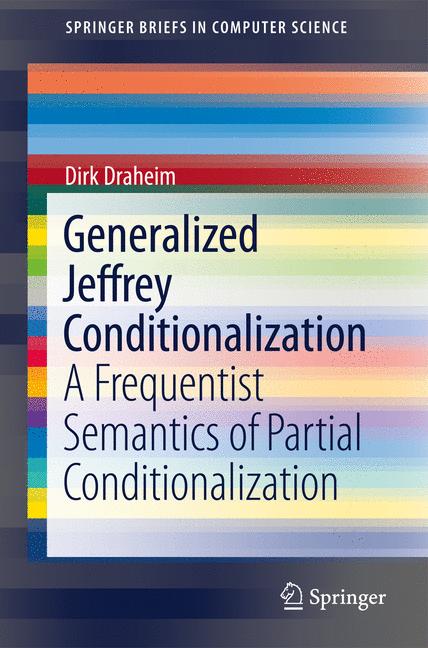
Generalized Jeffrey Conditionalization
☆☆☆☆☆
(0 reviews)
Lowest price (incl. delivery)
58,99 USD
Typical price563,11 PLN
Lowest (90 days)35,99 PLN
Offers7
Last updated6 gün önce
Price history (90 days)
Full history
2026-08-08
2026-08-15
| Güncellenme Tarihi | Fiyat |
|---|---|
| 2026-08-08 | 39,99 |
| 2026-08-14 | 35,99 |
| 2026-08-15 | 51,99 |
| Satıcı | Product price | Delivery | Toplam | Stok Durumu | Updated | |
|---|---|---|---|---|---|---|
| SP SpringerNatureLink Shop INT | 39,99 USD | 19,00 USD | 58,99 USD | Mevcut | 14 saat önce | View offer |
| SP SpringerNatureLink Shop INT | 7 149,00 JPY | 29,00 JPY | 7 178,00 JPY | Mevcut | 4 saat önce | View offer |
| SP Springer Nature Author | 7 149,00 JPY | 15,00 JPY | 7 164,00 JPY | Mevcut | 6 gün önce | View offer |
| SP SpringerNatureLink Shop INT | 49,99 USD | 25,00 USD | 74,99 USD | Mevcut | 13 saat önce | View offer |
| SP SpringerNatureLink Shop INT | 54,99 USD | free | 54,99 USD | Mevcut | 12 saat önce | View offer |
| SP SpringerNatureLink Shop INT | 54,99 USD | 25,00 USD | 79,99 USD | Mevcut | 12 saat önce | View offer |
| SP SpringerNatureLink Shop INT | 59,00 EUR | 29,00 EUR | 88,00 EUR | Mevcut | 11 saat önce | View offer |
Fiyatlar ve stok durumu değişebilir. Son Güncelleme: 08.08.2026 23:09.
0,0
☆☆☆☆☆
0 reviews
5★
0%
4★
0%
3★
0%
2★
0%
1★
0%
Product reviews
No reviews yet — be the first!
This book provides a frequentist semantics for conditionalization on partially known events, which is given as a straightforward generalization of classical conditional probability via so-called probability testbeds. It analyzes the resulting partial conditionalization, called frequentist partial (F.P.) conditionalization, from different angles, i.e., with respect to partitions, segmentation, independence, and chaining. It turns out that F.P. conditionalization meets and generalizes Jeffrey conditionalization, i.e., from partitions to arbitrary collections of events, opening it for reassessment and a range of potential applications. A counterpart of Jeffrey’s rule for the case of independence holds in our frequentist semantics. This result is compared to Jeffrey’s commutative chaining of independent updates. The postulate of Jeffrey's probability kinematics, which is rooted in the subjectivism of Frank P. Ramsey, is found to be a consequence in our frequentist semantics. This way the book creates a link between the Kolmogorov system of probability and one of the important Bayesian frameworks. Furthermore, it shows a preservation result for conditional probabilities under the full update range and compares F.P. semantics with an operational semantics of classical conditional probability in terms of so-called conditional events. Lastly, it looks at the subjectivist notion of desirabilities and proposes a more fine-grained analysis of desirabilities a posteriori. This book appeals to researchers who are involved in any kind of knowledge processing systems. F.P. conditionalization is a straightforward, fundamental concept that fits human intuition, and is systematically linked to one of the important Bayesian frameworks. As such, the book is interesting for anybody investigating the semantics of reasoning systems.
Similar products
 50 Years of Philosophy and Medicine
from $107.30
50 Years of Philosophy and Medicine
from $107.30
 Understanding Cybersecurity Law and Digital Privacy
from $122.63
Understanding Cybersecurity Law and Digital Privacy
from $122.63
 Decisions in International Trade and Logistics
from $122.63
Decisions in International Trade and Logistics
from $122.63
 Advances in Economic Measurement
from $122.63
Advances in Economic Measurement
from $122.63
 Nanomaterials
from $137.96
Nanomaterials
from $137.96
 Sustainable Scaffolds-based Strategies in Tissue Engineering and Regenerative Medicine
from $162.87
Sustainable Scaffolds-based Strategies in Tissue Engineering and Regenerative Medicine
from $162.87
 Narratives in Educational Research
from $162.87
Narratives in Educational Research
from $162.87
 Environmental Biology of the Young Chinese Sturgeon
from $210.78
Environmental Biology of the Young Chinese Sturgeon
from $210.78