
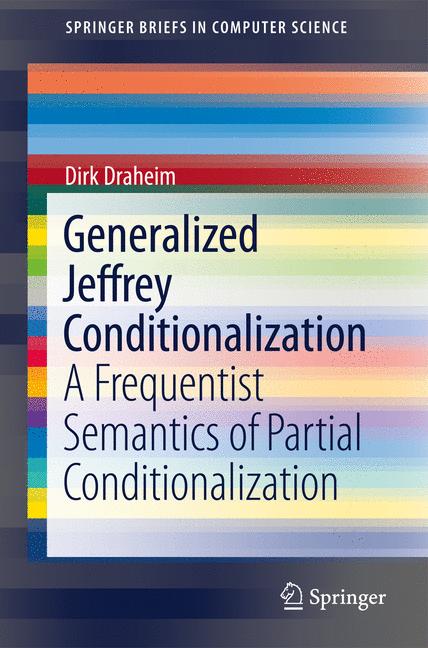
Generalized Jeffrey Conditionalization
☆☆☆☆☆
(0 opinii)
Najniższa cena (z dostawą)
7 164,00 JPY
Typowa cena314,07 PLN
Najniższa (90 dni)39,99 PLN
Liczba ofert2
Ostatnia aktualizacja1 dzień temu
| Sprzedawca | Cena produktu | Dostawa | Razem | Dostępność | Aktualizacja | |
|---|---|---|---|---|---|---|
| SP Springer Nature Author | 7 149,00 JPY | 15,00 JPY | 7 164,00 JPY | Dostępny | 1 dzień temu | Zobacz ofertę |
| SP SpringerNatureLink Shop INT | 59,00 EUR | 29,00 EUR | 88,00 EUR | Dostępny | 1 dzień temu | Zobacz ofertę |
Ceny i dostępność mogą ulec zmianie. Ostatnia aktualizacja: 08.08.2026 23:09.
0,0
☆☆☆☆☆
0 opinii
5★
0%
4★
0%
3★
0%
2★
0%
1★
0%
Opinie o produkcie
Brak opinii — bądź pierwszy!
This book provides a frequentist semantics for conditionalization on partially known events, which is given as a straightforward generalization of classical conditional probability via so-called probability testbeds. It analyzes the resulting partial conditionalization, called frequentist partial (F.P.) conditionalization, from different angles, i.e., with respect to partitions, segmentation, independence, and chaining. It turns out that F.P. conditionalization meets and generalizes Jeffrey conditionalization, i.e., from partitions to arbitrary collections of events, opening it for reassessment and a range of potential applications. A counterpart of Jeffrey’s rule for the case of independence holds in our frequentist semantics. This result is compared to Jeffrey’s commutative chaining of independent updates. The postulate of Jeffrey's probability kinematics, which is rooted in the subjectivism of Frank P. Ramsey, is found to be a consequence in our frequentist semantics. This way the book creates a link between the Kolmogorov system of probability and one of the important Bayesian frameworks. Furthermore, it shows a preservation result for conditional probabilities under the full update range and compares F.P. semantics with an operational semantics of classical conditional probability in terms of so-called conditional events. Lastly, it looks at the subjectivist notion of desirabilities and proposes a more fine-grained analysis of desirabilities a posteriori. This book appeals to researchers who are involved in any kind of knowledge processing systems. F.P. conditionalization is a straightforward, fundamental concept that fits human intuition, and is systematically linked to one of the important Bayesian frameworks. As such, the book is interesting for anybody investigating the semantics of reasoning systems.
Podobne produkty
 Patient Safety Coaching
od $91.97
Patient Safety Coaching
od $91.97
 Ethnography and Diversity
od $69.30
Ethnography and Diversity
od $69.30
 Smart Villages
od $91.97
Smart Villages
od $91.97
 Nuclear Non-Proliferation in International Law - Volume VI
od $91.97
Nuclear Non-Proliferation in International Law - Volume VI
od $91.97
 The Price of Freedom
od $91.97
The Price of Freedom
od $91.97
 Eco-Social Policy in the OECD and the World Bank
od $91.97
Eco-Social Policy in the OECD and the World Bank
od $91.97
 Special Topics in Policing
od $122.58
Special Topics in Policing
od $122.58
 Music from the Heart
od $91.97
Music from the Heart
od $91.97