
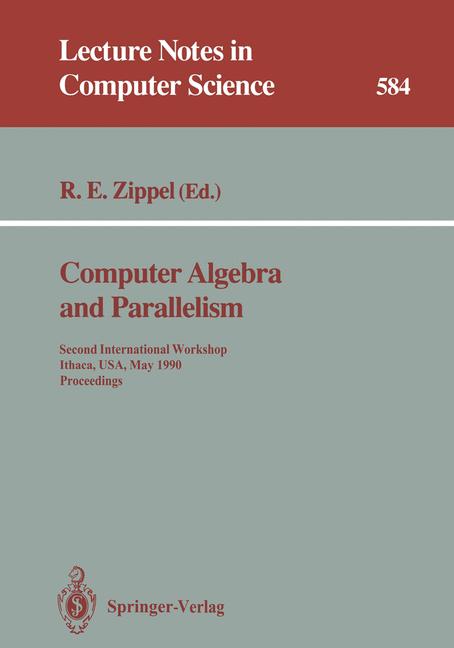
Computer Algebra and Parallelism
☆☆☆☆☆
(0 reviews)
Lowest price (incl. delivery)
7 178,00 JPY
Typical price524,53 PLN
Lowest (90 days)35,99 PLN
Offers6
Last updated1 hafta önce
Price history (90 days)
Full history
2026-08-08
2026-08-15
| Güncellenme Tarihi | Fiyat |
|---|---|
| 2026-08-08 | 39,99 |
| 2026-08-14 | 35,99 |
| 2026-08-15 | 51,99 |
| Satıcı | Product price | Delivery | Toplam | Stok Durumu | Updated | |
|---|---|---|---|---|---|---|
| SP SpringerNatureLink Shop INT | 7 149,00 JPY | 29,00 JPY | 7 178,00 JPY | Mevcut | 1 hafta önce | View offer |
| SP Springer Nature Author | 7 149,00 JPY | free | 7 149,00 JPY | Mevcut | 1 hafta önce | View offer |
| SP SpringerNatureLink Shop INT | 49,99 USD | free | 49,99 USD | Mevcut | 1 hafta önce | View offer |
| SP SpringerNatureLink Shop INT | 54,99 USD | free | 54,99 USD | Mevcut | 1 hafta önce | View offer |
| SP SpringerNatureLink Shop INT | 54,99 USD | 25,00 USD | 79,99 USD | Mevcut | 1 hafta önce | View offer |
| SP SpringerNatureLink Shop INT | 59,00 EUR | free | 59,00 EUR | Mevcut | 1 hafta önce | View offer |
Fiyatlar ve stok durumu değişebilir. Son Güncelleme: 08.08.2026 23:09.
0,0
☆☆☆☆☆
0 reviews
5★
0%
4★
0%
3★
0%
2★
0%
1★
0%
Product reviews
No reviews yet — be the first!
This book contains papers presented at a workshop on the use of parallel techniques in symbolic and algebraic computation held at Cornell University in May 1990. The eight papers in the book fall into three groups. The first three papers discuss particular programming substrates for parallel symbolic computation, especially for distributed memory machines. The next three papers discuss novel ways of computing with elements of finite fields and with algebraic numbers. The finite field technique is especially interesting since it uses the Connection Machine, a SIMD machine, to achievesurprising amounts of parallelism. One of the parallel computing substrates is also used to implement a real root isolation technique. One of the crucial algorithms in modern algebraic computation is computing the standard, or Gr|bner, basis of an ideal. The final two papers discuss two different approaches to speeding their computation. One uses vector processing on the Cray and achieves significant speed-ups. The other uses a distributed memory multiprocessor and effectively explores the trade-offs involved with different interconnect topologies of the multiprocessors.
Similar products
 50 Years of Philosophy and Medicine
from $107.30
50 Years of Philosophy and Medicine
from $107.30
 Understanding Cybersecurity Law and Digital Privacy
from $122.63
Understanding Cybersecurity Law and Digital Privacy
from $122.63
 Decisions in International Trade and Logistics
from $122.63
Decisions in International Trade and Logistics
from $122.63
 Advances in Economic Measurement
from $122.63
Advances in Economic Measurement
from $122.63
 Nanomaterials
from $137.96
Nanomaterials
from $137.96
 Sustainable Scaffolds-based Strategies in Tissue Engineering and Regenerative Medicine
from $162.87
Sustainable Scaffolds-based Strategies in Tissue Engineering and Regenerative Medicine
from $162.87
 Narratives in Educational Research
from $162.87
Narratives in Educational Research
from $162.87
 Environmental Biology of the Young Chinese Sturgeon
from $210.78
Environmental Biology of the Young Chinese Sturgeon
from $210.78