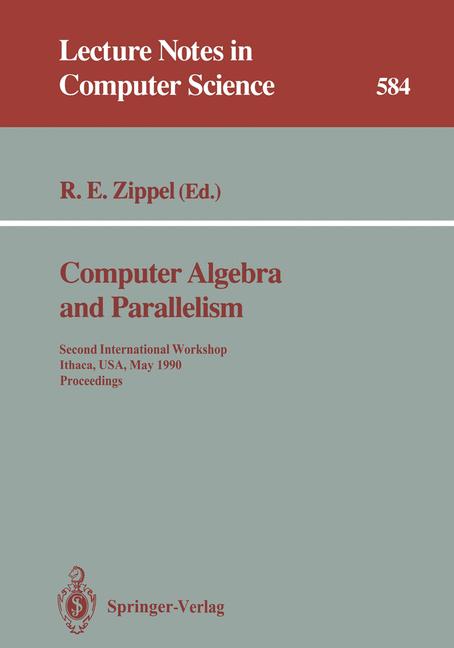
Computer Algebra and Parallelism
☆☆☆☆☆
(0 reviews)
Lowest price (incl. delivery)
7 178,00 JPY
- Offers
- 6
- Last updated
- před 3 měsíci
| Prodejce | Product price | Delivery | Celkem | Dostupnost | Updated | |
|---|---|---|---|---|---|---|
| SpringerNatureLink Shop INT | Product price 7 149,00 JPY ▲ 25,0% | Delivery 29,00 JPY | Celkem 7 178,00 JPY | Dostupnost Dostupné | Updated před 3 měsíci | View offer |
| SpringerNatureLink Shop INT | Product price 49,99 USD | Delivery free | Celkem 49,99 USD | Dostupnost Dostupné | Updated před 3 měsíci | View offer |
| SpringerNatureLink Shop INT | Product price 54,99 USD | Delivery free | Celkem 54,99 USD | Dostupnost Dostupné | Updated před 3 měsíci | View offer |
| …and 2 more variants from this seller (prices from 49,99 JPY to 7 149,00 JPY) | ||||||
| Springer Nature Author | Product price 7 149,00 JPY ▲ 25,0% | Delivery free | Celkem 7 149,00 JPY | Dostupnost Dostupné | Updated před 3 měsíci | View offer |
Ceny a dostupnost se mohou změnit. Naposledy aktualizováno: 08.08.2026 23:09.
0,0
☆☆☆☆☆
0 reviews
5★
0%
4★
0%
3★
0%
2★
0%
1★
0%
Product reviews
No reviews yet — be the first!
This book contains papers presented at a workshop on the use of parallel techniques in symbolic and algebraic computation held at Cornell University in May 1990. The eight papers in the book fall into three groups. The first three papers discuss particular programming substrates for parallel symbolic computation, especially for distributed memory machines. The next three papers discuss novel ways of computing with elements of finite fields and with algebraic numbers. The finite field technique is especially interesting since it uses the Connection Machine, a SIMD machine, to achievesurprising amounts of parallelism. One of the parallel computing substrates is also used to implement a real root isolation technique. One of the crucial algorithms in modern algebraic computation is computing the standard, or Gr|bner, basis of an ideal. The final two papers discuss two different approaches to speeding their computation. One uses vector processing on the Cray and achieves significant speed-ups. The other uses a distributed memory multiprocessor and effectively explores the trade-offs involved with different interconnect topologies of the multiprocessors.
Similar products