
CEMAF as a Census Method
☆☆☆☆☆
(0 reviews)
Lowest price (incl. delivery)
53,99 USD
Typical price44,83 PLN
Lowest (90 days)34,99 PLN
Offers4
Last updatedför 1 vecka sedan
Price history (90 days)
Full history
2026-08-08
2026-08-15
| Uppdaterad | Pris |
|---|---|
| 2026-08-08 | 34,99 |
| 2026-08-14 | 34,99 |
| 2026-08-15 | 53,45 |
| Säljare | Product price | Delivery | Totalt | Tillgänglighet | Updated | |
|---|---|---|---|---|---|---|
| SP SpringerNatureLink Shop INT | 34,99 USD | 19,00 USD | 53,99 USD | Tillgänglig | för 5 dagar sedan | View offer |
| SP SpringerNatureLink Shop INT | 34,99 USD | 19,00 USD | 53,99 USD | Tillgänglig | för 5 dagar sedan | View offer |
| SP SpringerNatureLink Shop INT | 53,45 EUR | 19,00 EUR | 72,45 EUR | Tillgänglig | för 5 dagar sedan | View offer |
| SP Springer Nature Author | 53,45 EUR | 15,00 EUR | 68,45 EUR | Tillgänglig | för 1 vecka sedan | View offer |
Priser och tillgänglighet kan ändras. Senast uppdaterad: 08.08.2026 10:13.
0,0
☆☆☆☆☆
0 reviews
5★
0%
4★
0%
3★
0%
2★
0%
1★
0%
Product reviews
No reviews yet — be the first!
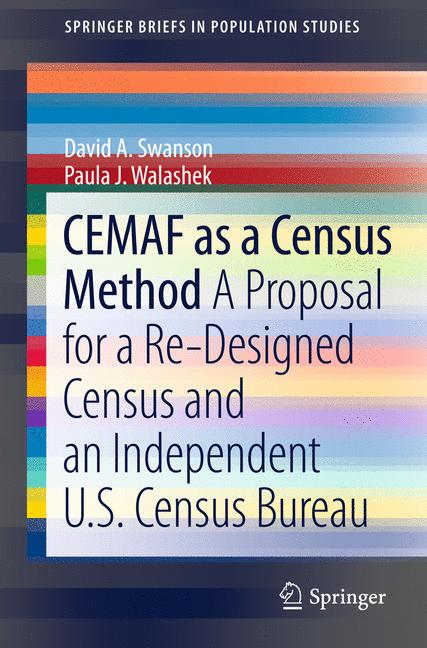
In provocative terms that push the envelope of technical, administrative, and legal capabilities, Swanson and Walashek propose a re-vamped US census based neither on the current system, self-enumeration, nor its predecessor, door-to-door canvassing. Instead, they propose that it be built on a combination of four elements: (1) administrative records; (2) the continuously updated Master Address File; (3) survey data; and (4) modeling and imputation techniques. They use “Census-Enhanced Master Address File (CEMAF) as a descriptive term for their proposal, which is based on four principles and includes a proposal for an independent Census Bureau. They argue that evidence suggests that the methods used to conduct traditional census counts may be at the end of their useful working lives, as evidenced by increasing costs and declining response rates. Some of their ideas will seem farfetched. However, Swanson and Walashek believe this is the time to discuss radical proposals as governments re-examine the utility of traditional census counts and consider reductions, as is the case in Canada and England. This SpringerBriefs should be on the reading list of staff in statistical agencies grappling with rising costs and declining response rates, as well as census stakeholders concerned about costs, accuracy, and census utility.
Similar products
 50 Years of Philosophy and Medicine
from $107.30
50 Years of Philosophy and Medicine
from $107.30
 Understanding Cybersecurity Law and Digital Privacy
from $122.63
Understanding Cybersecurity Law and Digital Privacy
from $122.63
 Decisions in International Trade and Logistics
from $122.63
Decisions in International Trade and Logistics
from $122.63
 Advances in Economic Measurement
from $122.63
Advances in Economic Measurement
from $122.63
 Nanomaterials
from $137.96
Nanomaterials
from $137.96
 Sustainable Scaffolds-based Strategies in Tissue Engineering and Regenerative Medicine
from $162.87
Sustainable Scaffolds-based Strategies in Tissue Engineering and Regenerative Medicine
from $162.87
 Narratives in Educational Research
from $162.87
Narratives in Educational Research
from $162.87
 Environmental Biology of the Young Chinese Sturgeon
from $210.78
Environmental Biology of the Young Chinese Sturgeon
from $210.78