
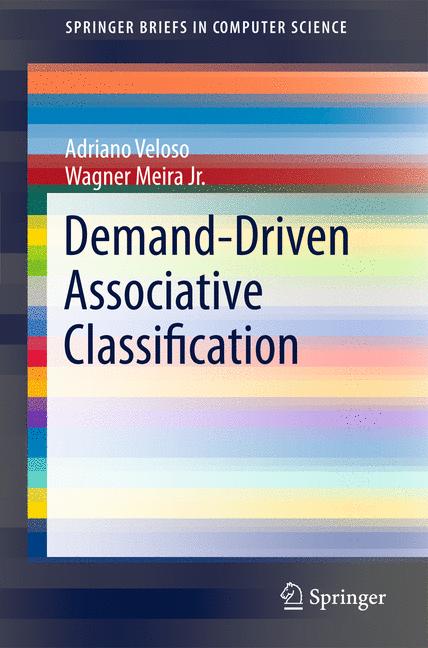
Demand-Driven Associative Classification
☆☆☆☆☆
(0 opinii)
Najniższa cena (z dostawą)
54,99 USD
Typowa cena137,92 PLN
Najniższa (90 dni)35,99 PLN
Liczba ofert6
Ostatnia aktualizacja6 dni temu
Historia ceny (90 dni)
Pełna historia
2026-08-08
2026-08-15
| Zaktualizowano | Cena |
|---|---|
| 2026-08-08 | 39,99 |
| 2026-08-14 | 35,99 |
| 2026-08-15 | 52,74 |
| Sprzedawca | Cena produktu | Dostawa | Razem | Dostępność | Aktualizacja | |
|---|---|---|---|---|---|---|
| SP SpringerNatureLink Shop INT | 39,99 USD | 15,00 USD | 54,99 USD | Dostępny | 1 godzina temu | Zobacz ofertę |
| SP SpringerNatureLink Shop INT | 39,99 USD | 29,00 USD | 68,99 USD | Dostępny | 1 godzina temu | Zobacz ofertę |
| SP Springer Nature Author | 7 149,00 JPY | 0 zł | 7 149,00 JPY | Dostępny | 6 dni temu | Zobacz ofertę |
| SP SpringerNatureLink Shop INT | 49,99 USD | 15,00 USD | 64,99 USD | Dostępny | 48 minut temu | Zobacz ofertę |
| SP SpringerNatureLink Shop INT | 49,99 USD | 0 zł | 49,99 USD | Dostępny | 48 minut temu | Zobacz ofertę |
| SP SpringerNatureLink Shop INT | 54,49 EUR | 0 zł | 54,49 EUR | Dostępny | 4 sekundy temu | Zobacz ofertę |
Ceny i dostępność mogą ulec zmianie. Ostatnia aktualizacja: 08.08.2026 23:08.
0,0
☆☆☆☆☆
0 opinii
5★
0%
4★
0%
3★
0%
2★
0%
1★
0%
Opinie o produkcie
Brak opinii — bądź pierwszy!
The ultimate goal of machines is to help humans to solve problems. Such problems range between two extremes: structured problems for which the solution is totally defined (and thus are easily programmed by humans), and random problems for which the solution is completely undefined (and thus cannot be programmed). Problems in the vast middle ground have solutions that cannot be well defined and are, thus, inherently hard to program. Machine Learning is the way to handle this vast middle ground, so that many tedious and difficult hand-coding tasks would be replaced by automatic learning methods. There are several machine learning tasks, and this work is focused on a major one, which is known as classification. Some classification problems are hard to solve, but we show that they can be decomposed into much simpler sub-problems. We also show that independently solving these sub-problems by taking into account their particular demands, often leads to improved classification performance.
Podobne produkty
 Selbstständige Erwerbstätigkeit und Erwerbskarrieren in späteren Lebensphasen
od $57.24
Selbstständige Erwerbstätigkeit und Erwerbskarrieren in späteren Lebensphasen
od $57.24
 Resonanzpädagogik: Weniger Rauschen, mehr Klang
od $57.24
Resonanzpädagogik: Weniger Rauschen, mehr Klang
od $57.24
 Grundlagen der Strahlungsphysik und des Strahlenschutzes
od $57.24
Grundlagen der Strahlungsphysik und des Strahlenschutzes
od $57.24
 Semantic Multimedia
od $57.78
Semantic Multimedia
od $57.78
 Strategies to Ameliorate Oxidative Stress During Assisted Reproduction
od $57.78
Strategies to Ameliorate Oxidative Stress During Assisted Reproduction
od $57.78
 Algebraic and Numeric Biology
od $57.78
Algebraic and Numeric Biology
od $57.78
 Economics of Grids, Clouds, Systems, and Services
od $57.78
Economics of Grids, Clouds, Systems, and Services
od $57.78
 Implementation and Application of Functional Languages
od $57.78
Implementation and Application of Functional Languages
od $57.78