
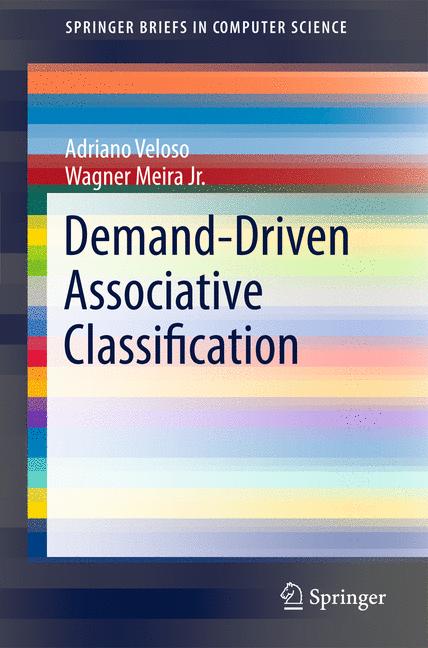
Demand-Driven Associative Classification
☆☆☆☆☆
(0 reviews)
Lowest price (incl. delivery)
7 164,00 JPY
Typical price610,90 PLN
Lowest (90 days)35,99 PLN
Offers6
Last updatedil y a 1 semaine
Price history (90 days)
Full history
2026-08-08
2026-08-15
| Mis à jour le | Prix |
|---|---|
| 2026-08-08 | 39,99 |
| 2026-08-14 | 35,99 |
| 2026-08-15 | 52,74 |
| Vendeur | Product price | Delivery | Total | Disponibilité | Updated | |
|---|---|---|---|---|---|---|
| SP SpringerNatureLink Shop INT | 7 149,00 JPY | 15,00 JPY | 7 164,00 JPY | Disponible | il y a 3 jours | View offer |
| SP Springer Nature Author | 7 149,00 JPY | free | 7 149,00 JPY | Disponible | il y a 1 semaine | View offer |
| SP SpringerNatureLink Shop INT | 49,99 USD | free | 49,99 USD | Disponible | il y a 3 jours | View offer |
| SP SpringerNatureLink Shop INT | 54,99 USD | 15,00 USD | 69,99 USD | Disponible | il y a 3 jours | View offer |
| SP SpringerNatureLink Shop INT | 54,99 USD | 29,00 USD | 83,99 USD | Disponible | il y a 3 jours | View offer |
| SP SpringerNatureLink Shop INT | 59,00 EUR | free | 59,00 EUR | Disponible | il y a 3 jours | View offer |
Les prix et la disponibilité peuvent changer. Dernière mise à jour: 08.08.2026 23:08.
0,0
☆☆☆☆☆
0 reviews
5★
0%
4★
0%
3★
0%
2★
0%
1★
0%
Product reviews
No reviews yet — be the first!
The ultimate goal of machines is to help humans to solve problems. Such problems range between two extremes: structured problems for which the solution is totally defined (and thus are easily programmed by humans), and random problems for which the solution is completely undefined (and thus cannot be programmed). Problems in the vast middle ground have solutions that cannot be well defined and are, thus, inherently hard to program. Machine Learning is the way to handle this vast middle ground, so that many tedious and difficult hand-coding tasks would be replaced by automatic learning methods. There are several machine learning tasks, and this work is focused on a major one, which is known as classification. Some classification problems are hard to solve, but we show that they can be decomposed into much simpler sub-problems. We also show that independently solving these sub-problems by taking into account their particular demands, often leads to improved classification performance.
Similar products
 50 Years of Philosophy and Medicine
from $107.30
50 Years of Philosophy and Medicine
from $107.30
 Understanding Cybersecurity Law and Digital Privacy
from $122.63
Understanding Cybersecurity Law and Digital Privacy
from $122.63
 Decisions in International Trade and Logistics
from $122.63
Decisions in International Trade and Logistics
from $122.63
 Advances in Economic Measurement
from $122.63
Advances in Economic Measurement
from $122.63
 Nanomaterials
from $137.96
Nanomaterials
from $137.96
 Sustainable Scaffolds-based Strategies in Tissue Engineering and Regenerative Medicine
from $162.87
Sustainable Scaffolds-based Strategies in Tissue Engineering and Regenerative Medicine
from $162.87
 Narratives in Educational Research
from $162.87
Narratives in Educational Research
from $162.87
 Environmental Biology of the Young Chinese Sturgeon
from $210.78
Environmental Biology of the Young Chinese Sturgeon
from $210.78