
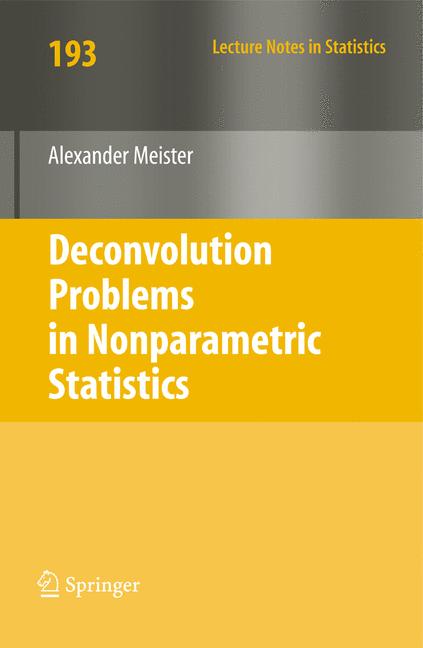
Deconvolution Problems in Nonparametric Statistics
☆☆☆☆☆
(0 opinii)
Najniższa cena (z dostawą)
108,49 EUR
Typowa cena93,52 PLN
Najniższa (90 dni)90,94 PLN
Liczba ofert2
Ostatnia aktualizacja1 dzień temu
| Sprzedawca | Cena produktu | Dostawa | Razem | Dostępność | Aktualizacja | |
|---|---|---|---|---|---|---|
| SP SpringerNatureLink Shop INT | 93,49 EUR | 15,00 EUR | 108,49 EUR | Dostępny | 1 dzień temu | Zobacz ofertę |
| SP Springer Nature Author | 100,50 EUR | 19,00 EUR | 119,50 EUR | Dostępny | 1 dzień temu | Zobacz ofertę |
Ceny i dostępność mogą ulec zmianie. Ostatnia aktualizacja: 08.08.2026 21:39.
EAN
9783540875567
Springer Nature
0,0
☆☆☆☆☆
0 opinii
5★
0%
4★
0%
3★
0%
2★
0%
1★
0%
Opinie o produkcie
Brak opinii — bądź pierwszy!
Deconvolution problems occur in many ?elds of nonparametric statistics, for example, density estimation based on contaminated data, nonparametric - gression with errors-in-variables, image and signal deblurring. During the last two decades, those topics have received more and more attention. As appli- tions of deconvolution procedures concern many real-life problems in eco- metrics, biometrics, medical statistics, image reconstruction, one can realize an increasing number of applied statisticians who are interested in nonpa- metric deconvolution methods; on the other hand, some deep results from Fourier analysis, functional analysis, and probability theory are required to understand the construction of deconvolution techniques and their properties so that deconvolution is also particularly challenging for mathematicians. Thegeneraldeconvolutionprobleminstatisticscanbedescribedasfollows: Our goal is estimating a function f while any empirical access is restricted to some quantity h = f?G = f(x?y)dG(y), (1. 1) that is, the convolution of f and some probability distribution G. Therefore, f can be estimated from some observations only indirectly. The strategy is ˆ estimating h ?rst; this means producing an empirical version h of h and, then, ˆ applying a deconvolution procedure to h to estimate f. In the mathematical context, we have to invert the convolution operator with G where some reg- ˆ ularization is required to guarantee that h is contained in the invertibility ˆ domain of the convolution operator. The estimator h has to be chosen with respect to the speci?c statistical experiment.
Podobne produkty
 Patient Safety Coaching
od $91.97
Patient Safety Coaching
od $91.97
 Ethnography and Diversity
od $69.30
Ethnography and Diversity
od $69.30
 Smart Villages
od $91.97
Smart Villages
od $91.97
 Nuclear Non-Proliferation in International Law - Volume VI
od $91.97
Nuclear Non-Proliferation in International Law - Volume VI
od $91.97
 The Price of Freedom
od $91.97
The Price of Freedom
od $91.97
 Eco-Social Policy in the OECD and the World Bank
od $91.97
Eco-Social Policy in the OECD and the World Bank
od $91.97
 Special Topics in Policing
od $122.58
Special Topics in Policing
od $122.58
 Music from the Heart
od $91.97
Music from the Heart
od $91.97