
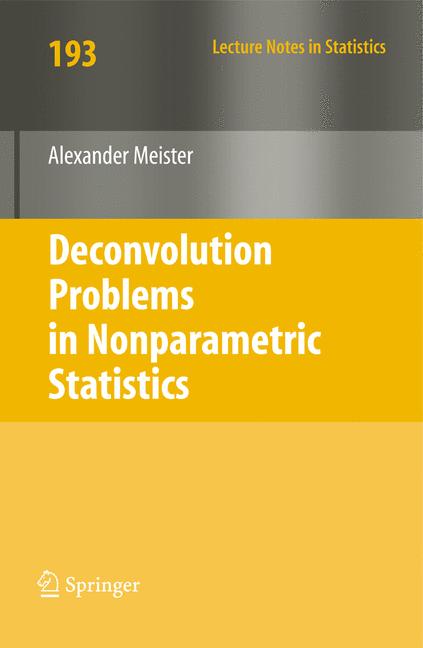
Deconvolution Problems in Nonparametric Statistics
☆☆☆☆☆
(0 reviews)
Lowest price (incl. delivery)
12 154,00 JPY
Typical price93,36 PLN
Lowest (90 days)88,39 PLN
Offers3
Last updated1日前
Price history (90 days)
Full history
2026-08-08
2026-08-15
| 更新日時 | 価格 |
|---|---|
| 2026-08-08 | 90,94 |
| 2026-08-15 | 88,39 |
| 販売者 | Product price | Delivery | 合計 | 在庫状況 | Updated | |
|---|---|---|---|---|---|---|
| SP SpringerNatureLink Shop INT | 12 154,00 JPY | free | 12 154,00 JPY | 在庫あり | 1日前 | View offer |
| SP SpringerNatureLink Shop INT | 100,50 EUR | 15,00 EUR | 115,50 EUR | 在庫あり | 1日前 | View offer |
| SP Springer Nature Author | 100,50 EUR | 19,00 EUR | 119,50 EUR | 在庫あり | 1週間前 | View offer |
価格や在庫状況は変更される場合があります。 最終更新: 15.08.2026 07:59.
EAN
9783540875567
Springer Nature
0,0
☆☆☆☆☆
0 reviews
5★
0%
4★
0%
3★
0%
2★
0%
1★
0%
Product reviews
No reviews yet — be the first!
Deconvolution problems occur in many ?elds of nonparametric statistics, for example, density estimation based on contaminated data, nonparametric - gression with errors-in-variables, image and signal deblurring. During the last two decades, those topics have received more and more attention. As appli- tions of deconvolution procedures concern many real-life problems in eco- metrics, biometrics, medical statistics, image reconstruction, one can realize an increasing number of applied statisticians who are interested in nonpa- metric deconvolution methods; on the other hand, some deep results from Fourier analysis, functional analysis, and probability theory are required to understand the construction of deconvolution techniques and their properties so that deconvolution is also particularly challenging for mathematicians. Thegeneraldeconvolutionprobleminstatisticscanbedescribedasfollows: Our goal is estimating a function f while any empirical access is restricted to some quantity h = f?G = f(x?y)dG(y), (1. 1) that is, the convolution of f and some probability distribution G. Therefore, f can be estimated from some observations only indirectly. The strategy is ˆ estimating h ?rst; this means producing an empirical version h of h and, then, ˆ applying a deconvolution procedure to h to estimate f. In the mathematical context, we have to invert the convolution operator with G where some reg- ˆ ularization is required to guarantee that h is contained in the invertibility ˆ domain of the convolution operator. The estimator h has to be chosen with respect to the speci?c statistical experiment.
Similar products
 50 Years of Philosophy and Medicine
from $107.30
50 Years of Philosophy and Medicine
from $107.30
 Understanding Cybersecurity Law and Digital Privacy
from $122.63
Understanding Cybersecurity Law and Digital Privacy
from $122.63
 Decisions in International Trade and Logistics
from $122.63
Decisions in International Trade and Logistics
from $122.63
 Advances in Economic Measurement
from $122.63
Advances in Economic Measurement
from $122.63
 Nanomaterials
from $137.96
Nanomaterials
from $137.96
 Sustainable Scaffolds-based Strategies in Tissue Engineering and Regenerative Medicine
from $162.87
Sustainable Scaffolds-based Strategies in Tissue Engineering and Regenerative Medicine
from $162.87
 Narratives in Educational Research
from $162.87
Narratives in Educational Research
from $162.87
 Environmental Biology of the Young Chinese Sturgeon
from $210.78
Environmental Biology of the Young Chinese Sturgeon
from $210.78