
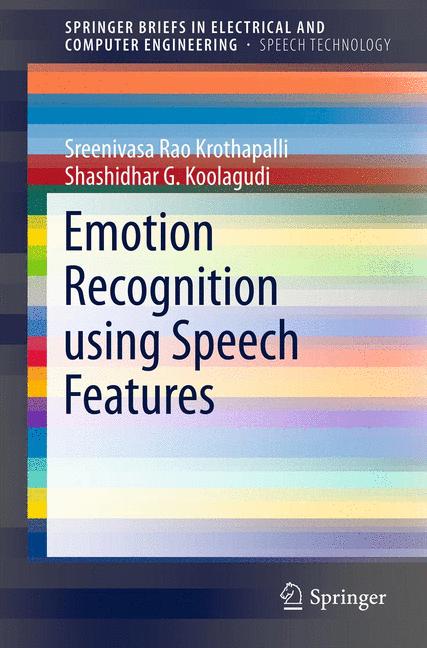
Emotion Recognition using Speech Features
☆☆☆☆☆
(0 reviews)
Lowest price (incl. delivery)
7 178,00 JPY
Typical price563,22 PLN
Lowest (90 days)35,99 PLN
Offers6
Last updated1주 전
Price history (90 days)
Full history
2026-08-08
2026-08-15
| 업데이트 일시 | 가격 |
|---|---|
| 2026-08-08 | 39,99 |
| 2026-08-14 | 35,99 |
| 2026-08-15 | 51,99 |
| 판매자 | Product price | Delivery | 합계 | 재고 여부 | Updated | |
|---|---|---|---|---|---|---|
| SP SpringerNatureLink Shop INT | 7 149,00 JPY | 29,00 JPY | 7 178,00 JPY | 구매 가능 | 1주 전 | View offer |
| SP Springer Nature Author | 7 149,00 JPY | free | 7 149,00 JPY | 구매 가능 | 1주 전 | View offer |
| SP SpringerNatureLink Shop INT | 49,99 USD | 19,00 USD | 68,99 USD | 구매 가능 | 1주 전 | View offer |
| SP SpringerNatureLink Shop INT | 54,99 USD | 25,00 USD | 79,99 USD | 구매 가능 | 1주 전 | View offer |
| SP SpringerNatureLink Shop INT | 54,99 USD | free | 54,99 USD | 구매 가능 | 1주 전 | View offer |
| SP SpringerNatureLink Shop INT | 59,00 EUR | 25,00 EUR | 84,00 EUR | 구매 가능 | 1주 전 | View offer |
가격과 재고 여부는 변경될 수 있습니다. 마지막 업데이트: 08.08.2026 23:08.
0,0
☆☆☆☆☆
0 reviews
5★
0%
4★
0%
3★
0%
2★
0%
1★
0%
Product reviews
No reviews yet — be the first!
“Emotion Recognition Using Speech Features” provides coverage of emotion-specific features present in speech. The author also discusses suitable models for capturing emotion-specific information for distinguishing different emotions. The content of this book is important for designing and developing natural and sophisticated speech systems. In this Brief, Drs. Rao and Koolagudi lead a discussion of how emotion-specific information is embedded in speech and how to acquire emotion-specific knowledge using appropriate statistical models. Additionally, the authors provide information about exploiting multiple evidences derived from various features and models. The acquired emotion-specific knowledge is useful for synthesizing emotions. Features includes discussion of: • Global and local prosodic features at syllable, word and phrase levels, helpful for capturing emotion-discriminative information; • Exploiting complementary evidences obtained from excitation sources, vocal tract systems and prosodic features in order to enhance the emotion recognition performance; • Proposed multi-stage and hybrid models for improving the emotion recognition performance. This brief is for researchers working in areas related to speech-based products such as mobile phone manufacturing companies, automobile companies, and entertainment products as well as researchers involved in basic and applied speech processing research.
Similar products
 50 Years of Philosophy and Medicine
from $107.30
50 Years of Philosophy and Medicine
from $107.30
 Understanding Cybersecurity Law and Digital Privacy
from $122.63
Understanding Cybersecurity Law and Digital Privacy
from $122.63
 Decisions in International Trade and Logistics
from $122.63
Decisions in International Trade and Logistics
from $122.63
 Advances in Economic Measurement
from $122.63
Advances in Economic Measurement
from $122.63
 Nanomaterials
from $137.96
Nanomaterials
from $137.96
 Sustainable Scaffolds-based Strategies in Tissue Engineering and Regenerative Medicine
from $162.87
Sustainable Scaffolds-based Strategies in Tissue Engineering and Regenerative Medicine
from $162.87
 Narratives in Educational Research
from $162.87
Narratives in Educational Research
from $162.87
 Environmental Biology of the Young Chinese Sturgeon
from $210.78
Environmental Biology of the Young Chinese Sturgeon
from $210.78