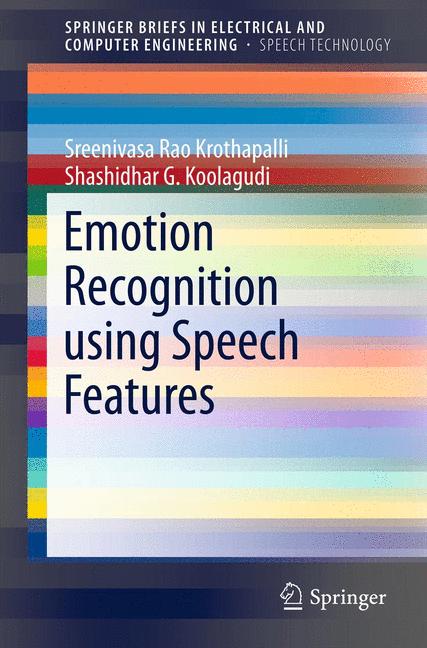
Emotion Recognition using Speech Features
☆☆☆☆☆
(0 reviews)
Lowest price (incl. delivery)
7 178,00 JPY
- Offers
- 6
- Last updated
- 3 bulan yang lalu
| Penjual | Product price | Delivery | Total | Ketersediaan | Updated | |
|---|---|---|---|---|---|---|
| SpringerNatureLink Shop INT | Product price 7 149,00 JPY ▲ 25,0% | Delivery 29,00 JPY | Total 7 178,00 JPY | Ketersediaan Tersedia | Updated 3 bulan yang lalu | View offer |
| SpringerNatureLink Shop INT | Product price 49,99 USD | Delivery 19,00 USD | Total 68,99 USD | Ketersediaan Tersedia | Updated 3 bulan yang lalu | View offer |
| SpringerNatureLink Shop INT | Product price 54,99 USD | Delivery 25,00 USD | Total 79,99 USD | Ketersediaan Tersedia | Updated 3 bulan yang lalu | View offer |
| …and 2 more variants from this seller (prices from 49,99 JPY to 7 149,00 JPY) | ||||||
| Springer Nature Author | Product price 7 149,00 JPY ▲ 25,0% | Delivery free | Total 7 149,00 JPY | Ketersediaan Tersedia | Updated 3 bulan yang lalu | View offer |
Harga dan ketersediaan dapat berubah. Terakhir Diperbarui: 08.08.2026 23:08.
0,0
☆☆☆☆☆
0 reviews
5★
0%
4★
0%
3★
0%
2★
0%
1★
0%
Product reviews
No reviews yet — be the first!
“Emotion Recognition Using Speech Features” provides coverage of emotion-specific features present in speech. The author also discusses suitable models for capturing emotion-specific information for distinguishing different emotions. The content of this book is important for designing and developing natural and sophisticated speech systems. In this Brief, Drs. Rao and Koolagudi lead a discussion of how emotion-specific information is embedded in speech and how to acquire emotion-specific knowledge using appropriate statistical models. Additionally, the authors provide information about exploiting multiple evidences derived from various features and models. The acquired emotion-specific knowledge is useful for synthesizing emotions. Features includes discussion of: • Global and local prosodic features at syllable, word and phrase levels, helpful for capturing emotion-discriminative information; • Exploiting complementary evidences obtained from excitation sources, vocal tract systems and prosodic features in order to enhance the emotion recognition performance; • Proposed multi-stage and hybrid models for improving the emotion recognition performance. This brief is for researchers working in areas related to speech-based products such as mobile phone manufacturing companies, automobile companies, and entertainment products as well as researchers involved in basic and applied speech processing research.
Similar products