
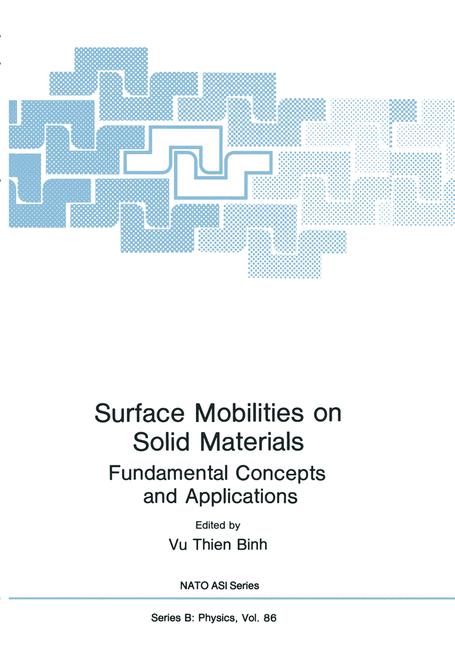
Surface Mobilities on Solid Materials
☆☆☆☆☆
(0 reviews)
Lowest price (incl. delivery)
7 149,00 JPY
Typical price362,20 PLN
Lowest (90 days)49,99 PLN
Offers2
Last updated21 hours ago
| Seller | Product price | Delivery | Total | Availability | Updated | |
|---|---|---|---|---|---|---|
| SP Springer Nature Author | 7 149,00 JPY | free | 7 149,00 JPY | Available | 21 hours ago | View offer |
| SP SpringerNatureLink Shop INT | 59,00 EUR | 29,00 EUR | 88,00 EUR | Available | 1 day ago | View offer |
Prices and availability may change. Last Updated: 08.08.2026 23:12.
0,0
☆☆☆☆☆
0 reviews
5★
0%
4★
0%
3★
0%
2★
0%
1★
0%
Product reviews
No reviews yet — be the first!
The surface of solids had long been considered simply the external boundary which determined the outside appearance of the solids but had no intrinsic character of its own. The concept that surfaces have specific properties and are the first and foremost means of communication between individual things and the rest of the universe is fairly new, coming into prominence only in the early sixties. This new concept of surface properties was the result of a vast accumulation of knowledge due to recent development of research in this area. This breakthrough of surface science resulted from the combined action of four factors: (i) control of surface sample prep aration, (ii) control of the surface's environment, (iii) improve ment of measurement tools and techniques, and (iv) the importance of surface properties in many new industrial areas. Nearly eighty techniques are now available to help us answer to the following questions: what is the surface structure or arrangement of surface atoms? what are the atomic species present? what is the spatial distribution of foreign atoms? what are the nature and distribution of possible defects on the surface? what is the electronic structure of the surface atoms? what is the motion of atoms on the surface? In general, two or more analytical techniques are used concurrently to assure unequivocal answers to problems. Different techniques employ different combina. tions of incident probes and the scattered or secondary particles that convey information regarding the sur faces.
Similar products
 Patient Safety Coaching
from $91.97
Patient Safety Coaching
from $91.97
 Ethnography and Diversity
from $69.30
Ethnography and Diversity
from $69.30
 Smart Villages
from $91.97
Smart Villages
from $91.97
 Nuclear Non-Proliferation in International Law - Volume VI
from $91.97
Nuclear Non-Proliferation in International Law - Volume VI
from $91.97
 The Price of Freedom
from $91.97
The Price of Freedom
from $91.97
 Eco-Social Policy in the OECD and the World Bank
from $91.97
Eco-Social Policy in the OECD and the World Bank
from $91.97
 Special Topics in Policing
from $122.58
Special Topics in Policing
from $122.58
 Music from the Heart
from $91.97
Music from the Heart
from $91.97