
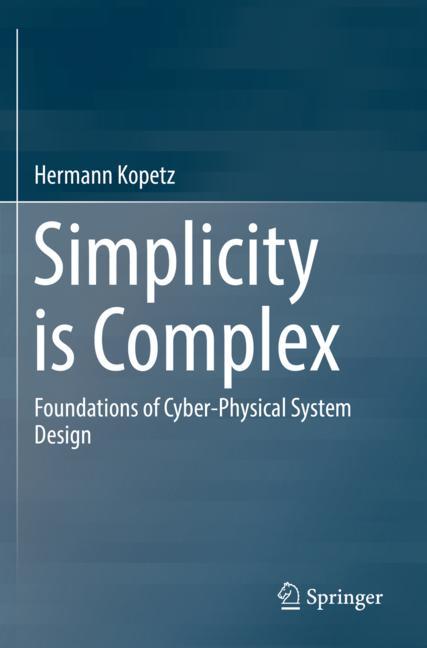
Simplicity is Complex
☆☆☆☆☆
(0 reviews)
Lowest price (incl. delivery)
119,00 USD
Typical price1 972,59 PLN
Lowest (90 days)117,69 PLN
Offers7
Last updated2 days ago
Price history (90 days)
Full history
2026-08-08
2026-08-15
| Updated At | Price |
|---|---|
| 2026-08-08 | 117,69 |
| 2026-08-15 | 119,99 |
| Seller | Product price | Delivery | Total | Availability | Updated | |
|---|---|---|---|---|---|---|
| SP SpringerNatureLink Shop INT | 119,00 USD | free | 119,00 USD | Available | 2 days ago | View offer |
| SP SpringerNatureLink Shop INT | 20 019,00 JPY | 15,00 JPY | 20 034,00 JPY | Available | 2 days ago | View offer |
| SP Springer Nature Author | 20 019,00 JPY | 25,00 JPY | 20 044,00 JPY | Available | 1 week ago | View offer |
| SP SpringerNatureLink Shop INT | 139,99 USD | 29,00 USD | 168,99 USD | Available | 2 days ago | View offer |
| SP SpringerNatureLink Shop INT | 159,99 USD | free | 159,99 USD | Available | 2 days ago | View offer |
| SP SpringerNatureLink Shop INT | 159,99 USD | free | 159,99 USD | Available | 2 days ago | View offer |
| SP SpringerNatureLink Shop INT | 165,50 EUR | 15,00 EUR | 180,50 EUR | Available | 2 days ago | View offer |
Prices and availability may change. Last Updated: 15.08.2026 04:15.
0,0
☆☆☆☆☆
0 reviews
5★
0%
4★
0%
3★
0%
2★
0%
1★
0%
Product reviews
No reviews yet — be the first!
This book investigates the characteristics of simple versus complex systems, and what the properties of a cyber-physical system design are that contribute to an effective implementation and make the system understandable, simple to use, and easy to maintain. The targeted audience is engineers, managers and advanced students who are involved in the design of cyber-physical systems and are willing to spend some time outside the silo of their daily work in order to widen their background and appreciation for the pervasive problems of system complexity. In the past, design of a process-control system (now called cyber-physical systems) was more of an art than an engineering endeavor. The software technology of that time was concerned primarily with functional correctness and did not pay much attention to the temporal dimension of program execution, which is as important as functional correctness when a physical process must be controlled. In the ensuing years, many problems in the design of cyber-physical systems were simplified. But with an increase in the functional requirements and system size, the complexity problems have appeared again in a different disguise. A sound understanding of the complexity problem requires some insight in cognition, human problem solving, psychology, and parts of philosophy. This book presents the essence of the author’s thinking about complexity, accumulated over the past forty years.
Similar products
 50 Years of Philosophy and Medicine
from $107.30
50 Years of Philosophy and Medicine
from $107.30
 Understanding Cybersecurity Law and Digital Privacy
from $122.63
Understanding Cybersecurity Law and Digital Privacy
from $122.63
 Decisions in International Trade and Logistics
from $122.63
Decisions in International Trade and Logistics
from $122.63
 Advances in Economic Measurement
from $122.63
Advances in Economic Measurement
from $122.63
 Nanomaterials
from $137.96
Nanomaterials
from $137.96
 Sustainable Scaffolds-based Strategies in Tissue Engineering and Regenerative Medicine
from $162.87
Sustainable Scaffolds-based Strategies in Tissue Engineering and Regenerative Medicine
from $162.87
 Narratives in Educational Research
from $162.87
Narratives in Educational Research
from $162.87
 Environmental Biology of the Young Chinese Sturgeon
from $210.78
Environmental Biology of the Young Chinese Sturgeon
from $210.78