
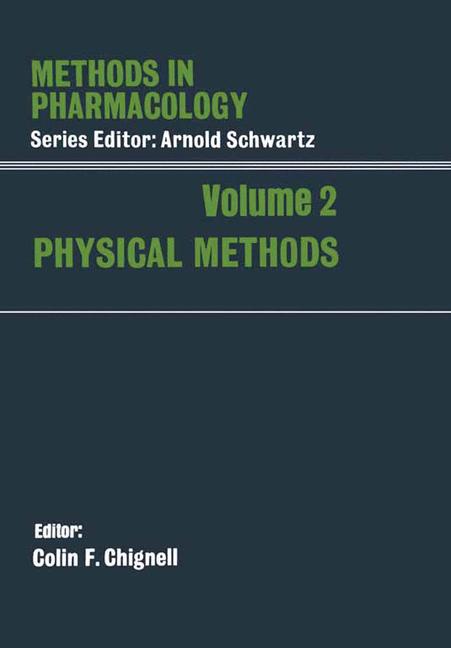
Physical Methods
☆☆☆☆☆
(0 reviews)
Lowest price (incl. delivery)
7 168,00 JPY
Typical price449,45 PLN
Lowest (90 days)44,99 PLN
Offers7
Last updated1 week ago
Price history (90 days)
Full history
2026-08-08
2026-08-15
| Updated At | Price |
|---|---|
| 2026-08-08 | 49,99 |
| 2026-08-14 | 44,99 |
| 2026-08-15 | 51,99 |
| Seller | Product price | Delivery | Total | Availability | Updated | |
|---|---|---|---|---|---|---|
| SP SpringerNatureLink Shop INT | 7 149,00 JPY | 19,00 JPY | 7 168,00 JPY | Available | 3 days ago | View offer |
| SP Springer Nature Author | 7 149,00 JPY | free | 7 149,00 JPY | Available | 1 week ago | View offer |
| SP SpringerNatureLink Shop INT | 49,99 USD | free | 49,99 USD | Available | 3 days ago | View offer |
| SP SpringerNatureLink Shop INT | 49,99 USD | 25,00 USD | 74,99 USD | Available | 3 days ago | View offer |
| SP SpringerNatureLink Shop INT | 54,99 USD | 15,00 USD | 69,99 USD | Available | 3 days ago | View offer |
| SP SpringerNatureLink Shop INT | 54,99 USD | free | 54,99 USD | Available | 3 days ago | View offer |
| SP SpringerNatureLink Shop INT | 59,00 EUR | 25,00 EUR | 84,00 EUR | Available | 3 days ago | View offer |
Prices and availability may change. Last Updated: 08.08.2026 23:12.
0,0
☆☆☆☆☆
0 reviews
5★
0%
4★
0%
3★
0%
2★
0%
1★
0%
Product reviews
No reviews yet — be the first!
This volume, the second in the Methods in Pharmacology series, contains some of the physical methods which either have been or could be applied to pharmaco logical problems. A major emphasis has been placed on spectroscopic techniques, particularly those, such as optical rotatory dispersion and circular dichroism, fluorescence spectroscopy, magnetic resonance spectroscopy, ultraviolet absorption spectroscopy, stopped flow and relaxation spectrometry, Mossbauer spectroscopy, light scatter and x-ray crystallography, that can be used to study drug interactions with biological systems at a molecular level. Although phosphorescence spectro scopy and oscillographic polarography can also be used to study drug interactions, their main usefulness is in the detection and estimation of drugs and their meta bolities in body tissues and fluids. Mass spectrometry is a powerful tool for study ing the metabolism of drugs as well as for detecting abnormal endogenous metabolites in the body. Finally, heatburst microcalorimetry is a non spectroscopic technique that can be used to study how drugs and other ligands interact with biological macromolecules. Each chapter contains a brief introduction to the theoretical basis for each technique as well as a description of the instrumentation involved. This is followed by a section describing the application of the technique to pharmacological prob lems. Where these are not available, examples have been drawn from the other life sciences. In a final section, some further applications of each technique to problems in pharmacology are suggested.
Similar products
 50 Years of Philosophy and Medicine
from $107.30
50 Years of Philosophy and Medicine
from $107.30
 Understanding Cybersecurity Law and Digital Privacy
from $122.63
Understanding Cybersecurity Law and Digital Privacy
from $122.63
 Decisions in International Trade and Logistics
from $122.63
Decisions in International Trade and Logistics
from $122.63
 Advances in Economic Measurement
from $122.63
Advances in Economic Measurement
from $122.63
 Nanomaterials
from $137.96
Nanomaterials
from $137.96
 Sustainable Scaffolds-based Strategies in Tissue Engineering and Regenerative Medicine
from $162.87
Sustainable Scaffolds-based Strategies in Tissue Engineering and Regenerative Medicine
from $162.87
 Narratives in Educational Research
from $162.87
Narratives in Educational Research
from $162.87
 Environmental Biology of the Young Chinese Sturgeon
from $210.78
Environmental Biology of the Young Chinese Sturgeon
from $210.78