
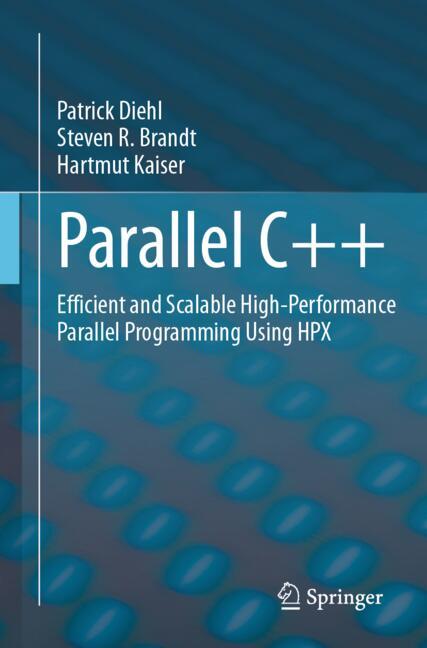
Parallel C++
☆☆☆☆☆
(0 reviews)
Lowest price (incl. delivery)
55,99 USD
Typical price47,55 PLN
Lowest (90 days)41,19 PLN
Offers2
Last updated1 day ago
| Seller | Product price | Delivery | Total | Availability | Updated | |
|---|---|---|---|---|---|---|
| SP SpringerNatureLink Shop INT | 55,99 USD | free | 55,99 USD | Available | 1 day ago | View offer |
| SP Springer Nature Author | 55,99 USD | 29,00 USD | 84,99 USD | Available | 1 day ago | View offer |
Prices and availability may change. Last Updated: 08.08.2026 12:17.
0,0
☆☆☆☆☆
0 reviews
5★
0%
4★
0%
3★
0%
2★
0%
1★
0%
Product reviews
No reviews yet — be the first!
This textbook focuses on practical parallel C++ programming at the graduate student level. In particular, it shows the APIs and related language features in the C++ 17 and C++ 20 standards, covering both single node and distributed systems. It shows that with the parallel features in the C++ 17 and C++ 20 standards, learning meta-languages like OpenMP is no longer necessary. Using the C++ standard library for parallelism and concurrency (HPX), the same language features can be extended to distributed codes, providing a higher-level C++ interface to distributed programming than the Message Passing Interface (MPI). The book starts with the single-threaded implementation of the fractal sets, e.g. Julia set, and Mandelbrot set, using the C++ Standard Library (SL)’s container and algorithms. This code base is used for parallel implementation using low-level threads, asynchronous programming, parallel algorithms, and coroutines. The asynchronous programming examples are then extended to distributed programming using the C++ standard library for parallelism and concurrency (HPX). Octo-Tiger, an astrophysics code for stellar merger, is used as a showcase for a portable, efficient, and scalable high-performance application using HPX. The book’s core audience is advanced undergraduate and graduate students who want to learn the basics of parallel and distributed C++ programming but are not computer science majors. Basic C++ knowledge, like functions, classes, loops, and conditional statements, is assumed as a requirement, while C++ advanced topics, like generic programming, lambda functions, smart pointers, and move semantics, are briefly summarized in the appendix.
Similar products
 Patient Safety Coaching
from $91.97
Patient Safety Coaching
from $91.97
 Ethnography and Diversity
from $69.30
Ethnography and Diversity
from $69.30
 Smart Villages
from $91.97
Smart Villages
from $91.97
 Nuclear Non-Proliferation in International Law - Volume VI
from $91.97
Nuclear Non-Proliferation in International Law - Volume VI
from $91.97
 The Price of Freedom
from $91.97
The Price of Freedom
from $91.97
 Eco-Social Policy in the OECD and the World Bank
from $91.97
Eco-Social Policy in the OECD and the World Bank
from $91.97
 Special Topics in Policing
from $122.58
Special Topics in Policing
from $122.58
 Music from the Heart
from $91.97
Music from the Heart
from $91.97