
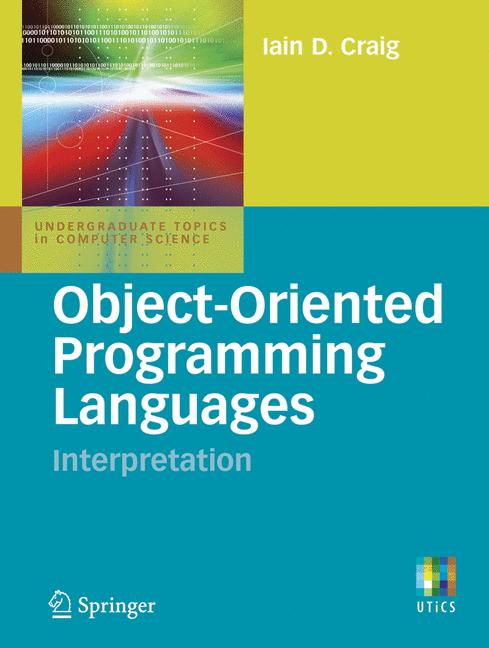
Object-Oriented Programming Languages: Interpretation
☆☆☆☆☆
(0 reviews)
Lowest price (incl. delivery)
4 998,00 JPY
Typical price162,75 PLN
Lowest (90 days)14,60 PLN
Offers3
Last updated22 hours ago
Price history (90 days)
Full history
2026-08-07
2026-08-08
| Updated At | Price |
|---|---|
| 2026-08-07 | 14,60 |
| 2026-08-08 | 34,95 |
| Seller | Product price | Delivery | Total | Availability | Updated | |
|---|---|---|---|---|---|---|
| SP Springer Nature Author | 4 998,00 JPY | free | 4 998,00 JPY | Available | 4 hours ago | View offer |
| SP SpringerNatureLink Shop INT | 38,45 EUR | 19,00 EUR | 57,45 EUR | Available | 19 hours ago | View offer |
| VI VitalSource | 199,24 ZAR | free | 199,24 ZAR | Available | 22 hours ago | View offer |
Prices and availability may change. Last Updated: 08.08.2026 05:20.
EAN
9781846287732
Springer Nature
0,0
☆☆☆☆☆
0 reviews
5★
0%
4★
0%
3★
0%
2★
0%
1★
0%
Product reviews
No reviews yet — be the first!
1.1 Introduction Object-oriented programming has opened a great many perspectives on the concept of software and has been hailed as part of the solution to the so-called “software crisis”. It has given the possibility that software components can be constructedandreusedwithconsiderablymorecredibility.Therearenowmany case studies in which the reuse of object-oriented components has been made and analysed. Object-oriented programming relates the programming activity to that of modelling or simulation; objects are identi?ed by a correspondence with the objects found in the application area of the program and are used to model those domain operations. Object-oriented programming also opens the prospect of more ?exible software that is able to respond dynamically to the needs of the application at runtime. It is very easy to think that object-oriented programming can be performed in only one way. The prevalence of C++ and Java suggests that they are the onlywaytoapproachtheproblemofwhatanobject-orientedprogrammingl- guage should look like. There are many approaches to this way of programming andC++andJavaexemplifyjustoneofthesedi?erentapproaches.Indeed,the wayinwhichtheconceptoftheobjectisinterpreteddi?ersbetweenapproaches and between languages. The two main approaches found in object-oriented programming languages are, respectively, class-based and prototype-based languages. Class-based l- guages are exempli?ed by Smalltalk [34], C++ [75, 74] and Java [47]. This 2 1. Introduction approach is based upon the identi?cation of common properties of objects and their description in terms of a de?nitional structure called a class. The objects manipulated by class-based programs are the result of instantiating classes.
Similar products
 Patient Safety Coaching
from $91.97
Patient Safety Coaching
from $91.97
 Ethnography and Diversity
from $69.30
Ethnography and Diversity
from $69.30
 Smart Villages
from $91.97
Smart Villages
from $91.97
 Nuclear Non-Proliferation in International Law - Volume VI
from $91.97
Nuclear Non-Proliferation in International Law - Volume VI
from $91.97
 The Price of Freedom
from $91.97
The Price of Freedom
from $91.97
 Eco-Social Policy in the OECD and the World Bank
from $91.97
Eco-Social Policy in the OECD and the World Bank
from $91.97
 Special Topics in Policing
from $122.58
Special Topics in Policing
from $122.58
 Music from the Heart
from $91.97
Music from the Heart
from $91.97