
Learning and Generalisation
☆☆☆☆☆
(0 reviews)
Lowest price (incl. delivery)
168,00 USD
Typical price182,14 PLN
Lowest (90 days)149,79 PLN
Offers8
Last updated3 days ago
Price history (90 days)
Full history
2026-08-08
2026-08-15
| Updated At | Price |
|---|---|
| 2026-08-08 | 149,79 |
| 2026-08-15 | 159,99 |
| Seller | Product price | Delivery | Total | Availability | Updated | |
|---|---|---|---|---|---|---|
| SP SpringerNatureLink Shop INT | 149,00 USD | 19,00 USD | 168,00 USD | Available | 3 days ago | View offer |
| SP SpringerNatureLink Shop INT | 149,79 EUR | 25,00 EUR | 174,79 EUR | Available | 3 days ago | View offer |
| SP SpringerNatureLink Shop INT | 179,99 USD | free | 179,99 USD | Available | 3 days ago | View offer |
| SP SpringerNatureLink Shop INT | 179,99 USD | 19,00 USD | 198,99 USD | Available | 3 days ago | View offer |
| SP SpringerNatureLink Shop INT | 199,99 USD | 25,00 USD | 224,99 USD | Available | 3 days ago | View offer |
| SP SpringerNatureLink Shop INT | 199,99 USD | free | 199,99 USD | Available | 3 days ago | View offer |
| SP Springer Nature Author | 199,99 USD | free | 199,99 USD | Available | 1 week ago | View offer |
| SP SpringerNatureLink Shop INT | 197,99 EUR | free | 197,99 EUR | Available | 3 days ago | View offer |
Prices and availability may change. Last Updated: 15.08.2026 06:44.
0,0
☆☆☆☆☆
0 reviews
5★
0%
4★
0%
3★
0%
2★
0%
1★
0%
Product reviews
No reviews yet — be the first!
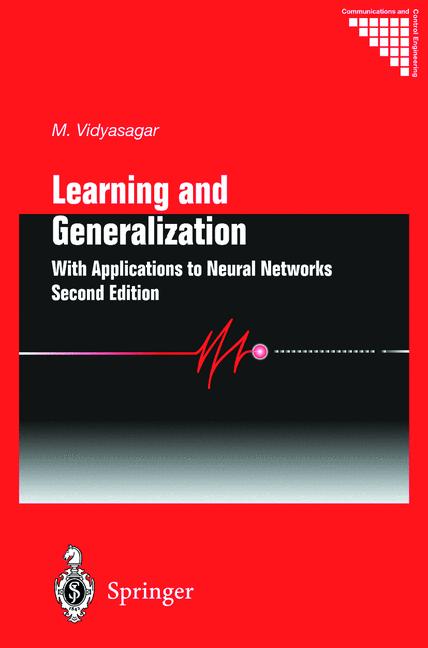
Learning and Generalization provides a formal mathematical theory addressing intuitive questions of the type: • How does a machine learn a concept on the basis of examples? • How can a neural network, after training, correctly predict the outcome of a previously unseen input? • How much training is required to achieve a given level of accuracy in the prediction? • How can one identify the dynamical behaviour of a nonlinear control system by observing its input-output behaviour over a finite time? The second edition covers new areas including: • support vector machines; • fat-shattering dimensions and applications to neural network learning; • learning with dependent samples generated by a beta-mixing process; • connections between system identification and learning theory; • probabilistic solution of 'intractable problems' in robust control and matrix theory using randomized algorithms. It also contains solutions to some of the open problems posed in the first edition, while adding new open problems.
Similar products
 50 Years of Philosophy and Medicine
from $107.30
50 Years of Philosophy and Medicine
from $107.30
 Understanding Cybersecurity Law and Digital Privacy
from $122.63
Understanding Cybersecurity Law and Digital Privacy
from $122.63
 Decisions in International Trade and Logistics
from $122.63
Decisions in International Trade and Logistics
from $122.63
 Advances in Economic Measurement
from $122.63
Advances in Economic Measurement
from $122.63
 Nanomaterials
from $137.96
Nanomaterials
from $137.96
 Sustainable Scaffolds-based Strategies in Tissue Engineering and Regenerative Medicine
from $162.87
Sustainable Scaffolds-based Strategies in Tissue Engineering and Regenerative Medicine
from $162.87
 Narratives in Educational Research
from $162.87
Narratives in Educational Research
from $162.87
 Environmental Biology of the Young Chinese Sturgeon
from $210.78
Environmental Biology of the Young Chinese Sturgeon
from $210.78