
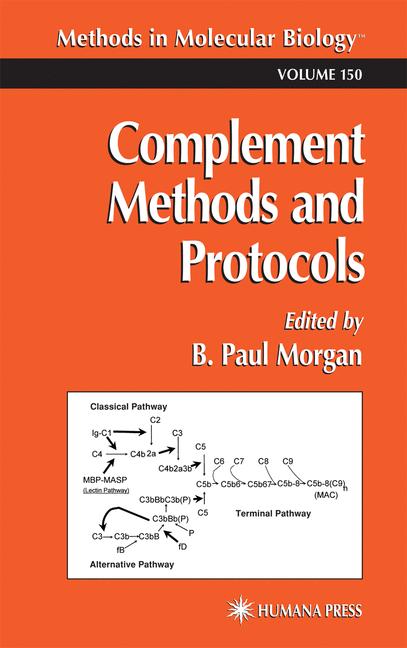
Complement Methods and Protocols
☆☆☆☆☆
(0 reviews)
Lowest price (incl. delivery)
21 468,00 JPY
Typical price3 437,30 PLN
Lowest (90 days)129,99 PLN
Offers1
Last updated1 day ago
| Seller | Product price | Delivery | Total | Availability | Updated | |
|---|---|---|---|---|---|---|
| SP Springer Nature Author | 21 449,00 JPY | 19,00 JPY | 21 468,00 JPY | Available | 1 day ago | View offer |
Prices and availability may change. Last Updated: 08.08.2026 23:33.
0,0
☆☆☆☆☆
0 reviews
5★
0%
4★
0%
3★
0%
2★
0%
1★
0%
Product reviews
No reviews yet — be the first!
The complement system, first described more than a century ago, was for many years the ugly duckling of the immunology world, but no more. Complement in recent years has blossomed into a fascinating and fast moving field of immediate relevance to clinical scientists in fields as diverse as transplantation biology, virology, and inflammation. Despite its emergence from the shadows, complement retains an unwarranted reputation for being “difficult.” This impression derives in large part from the superficially complicated nomenclature, a relic of the long and tortuous process of unraveling the system, of naming components in order of discovery rather than in a syst- atic manner. Once the barrier of nomenclature has been surmounted, then the true simplicity of the system becomes apparent. Complement comprises an activation system and a cytolytic system. The former has diverged to focus on complement to distinct targets—bacteria, - mune complexes, and others—so that texts now describe three activation pa- ways, closely related to one another, but each with some unique features. The cytolytic pathway is the same regardless of the activation process and kills cells by creating pores in the membrane. Complement plays an important role in killing bacteria and is essential for the proper handling of immune complexes. Problems occur when complement is activated in an inappropriate manner—the potent inflammation-inducing products of the cascade then cause unwanted tissue damage and destruction.
Similar products
 Gamma Knife Neurosurgery in the Management of Intracranial Disorders
from $210.78
Gamma Knife Neurosurgery in the Management of Intracranial Disorders
from $210.78
 SDGs in Construction Economics and Organization
from $210.78
SDGs in Construction Economics and Organization
from $210.78
 Emerging Therapies in Neurorehabilitation III
from $210.78
Emerging Therapies in Neurorehabilitation III
from $210.78
 Ground Improvement Techniques
from $220.36
Ground Improvement Techniques
from $220.36
 Anomaly Detection in Video Surveillance
from $220.36
Anomaly Detection in Video Surveillance
from $220.36
 Mechanism and Machine Science
from $287.42
Mechanism and Machine Science
from $287.42
 Protein-Protein Interactions as New Drug Targets
from $287.42
Protein-Protein Interactions as New Drug Targets
from $287.42
 Proceedings of the 7th International Conference of Transportation Research Group of India (CTRG 2023
from $287.42
Proceedings of the 7th International Conference of Transportation Research Group of India (CTRG 2023
from $287.42