
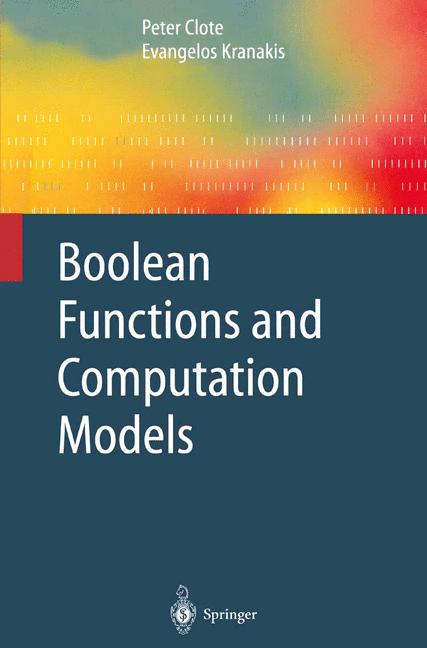
Boolean Functions and Computation Models
☆☆☆☆☆
(0 reviews)
Lowest price (incl. delivery)
93,99 GBP
Typical price95,00 PLN
Lowest (90 days)64,99 PLN
Offers4
Last updated1 week ago
Price history (90 days)
Full history
2026-08-08
2026-08-15
| Updated At | Price |
|---|---|
| 2026-08-08 | 84,99 |
| 2026-08-15 | 64,99 |
| Seller | Product price | Delivery | Total | Availability | Updated | |
|---|---|---|---|---|---|---|
| SP SpringerNatureLink Shop INT | 64,99 GBP | 29,00 GBP | 93,99 GBP | Available | 6 days ago | View offer |
| SP Springer Nature Author | 84,99 USD | free | 84,99 USD | Available | 1 week ago | View offer |
| SP SpringerNatureLink Shop INT | 109,00 USD | 29,00 USD | 138,00 USD | Available | 6 days ago | View offer |
| SP SpringerNatureLink Shop INT | 109,00 USD | free | 109,00 USD | Available | 6 days ago | View offer |
Prices and availability may change. Last Updated: 08.08.2026 14:21.
0,0
☆☆☆☆☆
0 reviews
5★
0%
4★
0%
3★
0%
2★
0%
1★
0%
Product reviews
No reviews yet — be the first!
The foundations of computational complexity theory go back to Alan Thring in the 1930s who was concerned with the existence of automatic procedures deciding the validity of mathematical statements. The first example of such a problem was the undecidability of the Halting Problem which is essentially the question of debugging a computer program: Will a given program eventu ally halt? Computational complexity today addresses the quantitative aspects of the solutions obtained: Is the problem to be solved tractable? But how does one measure the intractability of computation? Several ideas were proposed: A. Cobham [Cob65] raised the question of what is the right model in order to measure a "computation step" , M. Rabin [Rab60] proposed the introduction of axioms that a complexity measure should satisfy, and C. Shannon [Sha49] suggested the boolean circuit that computes a boolean function. However, an important question remains: What is the nature of computa tion? In 1957, John von Neumann [vN58] wrote in his notes for the Silliman Lectures concerning the nature of computation and the human brain that . . . logics and statistics should be primarily, although not exclusively, viewed as the basic tools of 'information theory'. Also, that body of experience which has grown up around the planning, evaluating, and coding of complicated logical and mathematical automata will be the focus of much of this information theory. The most typical, but not the only, such automata are, of course, the large electronic computing machines.
Similar products
 50 Years of Philosophy and Medicine
from $107.30
50 Years of Philosophy and Medicine
from $107.30
 Understanding Cybersecurity Law and Digital Privacy
from $122.63
Understanding Cybersecurity Law and Digital Privacy
from $122.63
 Decisions in International Trade and Logistics
from $122.63
Decisions in International Trade and Logistics
from $122.63
 Advances in Economic Measurement
from $122.63
Advances in Economic Measurement
from $122.63
 Nanomaterials
from $137.96
Nanomaterials
from $137.96
 Sustainable Scaffolds-based Strategies in Tissue Engineering and Regenerative Medicine
from $162.87
Sustainable Scaffolds-based Strategies in Tissue Engineering and Regenerative Medicine
from $162.87
 Narratives in Educational Research
from $162.87
Narratives in Educational Research
from $162.87
 Environmental Biology of the Young Chinese Sturgeon
from $210.78
Environmental Biology of the Young Chinese Sturgeon
from $210.78