
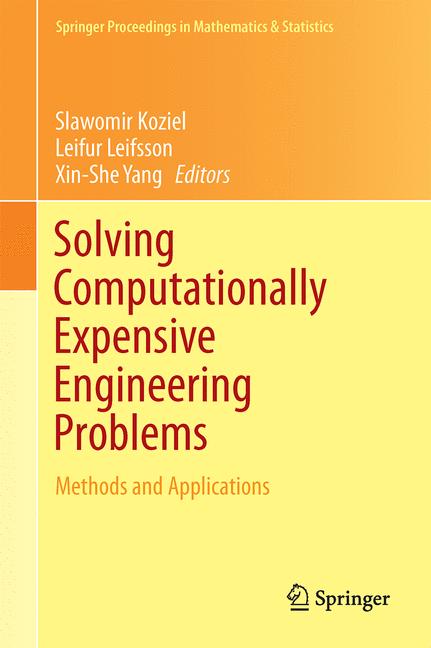
Solving Computationally Expensive Engineering Problems
☆☆☆☆☆
(0 reviews)
Lowest price (incl. delivery)
14 318,00 JPY
Typical price639,58 PLN
Lowest (90 days)84,99 PLN
Offers2
Last updated14 小时前
| 卖家 | Product price | Delivery | 总计 | 可用性 | Updated | |
|---|---|---|---|---|---|---|
| SP Springer Nature Author | 14 299,00 JPY | 19,00 JPY | 14 318,00 JPY | 可购买 | 14 小时前 | View offer |
| SP SpringerNatureLink Shop INT | 109,99 USD | free | 109,99 USD | 可购买 | 23 小时前 | View offer |
价格和库存可能会有变动。 最后更新: 08.08.2026 23:20.
0,0
☆☆☆☆☆
0 reviews
5★
0%
4★
0%
3★
0%
2★
0%
1★
0%
Product reviews
No reviews yet — be the first!
Computational complexity is a serious bottleneck for the design process in virtually any engineering area. While migration from prototyping and experimental-based design validation to verification using computer simulation models is inevitable and has a number of advantages, high computational costs of accurate, high-fidelity simulations can be a major issue that slows down the development of computer-aided design methodologies, particularly those exploiting automated design improvement procedures, e.g., numerical optimization. The continuous increase of available computational resources does not always translate into shortening of the design cycle because of the growing demand for higher accuracy and necessity to simulate larger and more complex systems. Accurate simulation of a single design of a given system may be as long as several hours, days or even weeks, which often makes design automation using conventional methods impractical or even prohibitive. Additional problems include numerical noise often present in the simulation data, possible presence of multiple locally optimum designs, as well as multiple conflicting objectives. In this edited book, various techniques that can alleviate solving computationally expensive engineering design problems are presented. One of the most promising approaches is the use of fast replacement models, so-called surrogates, that reliably represent the expensive, simulation-based model of the system/device of interest but they are much cheaper and analytically tractable. Here, a group of international experts summarize recent developments in the area and demonstrate applications in various disciplines of engineering and science. The main purpose of the work is to provide the basic concepts and formulations of the surrogate-based modeling and optimization paradigm, as well as discuss relevant modeling techniques, optimization algorithms and design procedures. Therefore, this book should be useful to researchers and engineers from any discipline where computationally heavy simulations are used on daily basis in the design process.
Similar products
 Patient Safety Coaching
from $91.97
Patient Safety Coaching
from $91.97
 Ethnography and Diversity
from $69.30
Ethnography and Diversity
from $69.30
 Smart Villages
from $91.97
Smart Villages
from $91.97
 Nuclear Non-Proliferation in International Law - Volume VI
from $91.97
Nuclear Non-Proliferation in International Law - Volume VI
from $91.97
 The Price of Freedom
from $91.97
The Price of Freedom
from $91.97
 Eco-Social Policy in the OECD and the World Bank
from $91.97
Eco-Social Policy in the OECD and the World Bank
from $91.97
 Special Topics in Policing
from $122.58
Special Topics in Policing
from $122.58
 Music from the Heart
from $91.97
Music from the Heart
from $91.97