
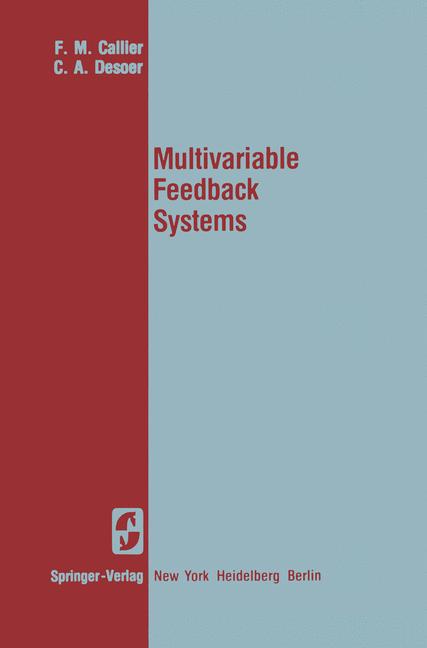
Multivariable Feedback Systems
☆☆☆☆☆
(0 reviews)
Lowest price (incl. delivery)
7 178,00 JPY
Typical price362,20 PLN
Lowest (90 days)49,99 PLN
Offers2
Last updated6 小时前
| 卖家 | Product price | Delivery | 总计 | 可用性 | Updated | |
|---|---|---|---|---|---|---|
| SP Springer Nature Author | 7 149,00 JPY | 29,00 JPY | 7 178,00 JPY | 可购买 | 6 小时前 | View offer |
| SP SpringerNatureLink Shop INT | 59,00 EUR | 25,00 EUR | 84,00 EUR | 可购买 | 17 小时前 | View offer |
价格和库存可能会有变动。 最后更新: 08.08.2026 23:11.
0,0
☆☆☆☆☆
0 reviews
5★
0%
4★
0%
3★
0%
2★
0%
1★
0%
Product reviews
No reviews yet — be the first!
This volume is the result of our teaching in the last few years of a first year graduate course on multivariable feedback systems addressed to control engineers. The prerequisites are modest: an undergraduate course in control (for acquaintance with concepts, terms, and design goals) and a senior-graduate course in linear systems. This volume covers lumped linear time-invariant multi-input multi-output systems with strong emphasis on control problems. The purpose is to provide a rapid introduction to some of the main and simpler results of control theory and to provide access to the current literature. Note that our exposition pays particular attention to the time-domain behavior of the systems under study. Note also that we cover neither optimization nor stochastic systems since these topics are treated in separate courses. As is obvious from its abundant literature, multivariable control is a very rapidly developing field. Consequently, we have no expectation that our exposition will become definitive; however, we hope that our efforts will be found useful. To get an idea of the contents, we suggest reading carefully the table of contents and the introduction of the chapters. Roughly, Chapter 1 is an introduction to feedback issues in a multivariable context (desensitization, large gain, singular values, etc. ). Chapters 2 and 3 cover the mathematical tools for handling transfer functions as polynomial-matrix fractions and for studying systems described by polynomial matrices. Chapter 4 uses these tools to cover the general theory of interconnected systems.
Similar products
 Patient Safety Coaching
from $91.97
Patient Safety Coaching
from $91.97
 Ethnography and Diversity
from $69.30
Ethnography and Diversity
from $69.30
 Smart Villages
from $91.97
Smart Villages
from $91.97
 Nuclear Non-Proliferation in International Law - Volume VI
from $91.97
Nuclear Non-Proliferation in International Law - Volume VI
from $91.97
 The Price of Freedom
from $91.97
The Price of Freedom
from $91.97
 Eco-Social Policy in the OECD and the World Bank
from $91.97
Eco-Social Policy in the OECD and the World Bank
from $91.97
 Special Topics in Policing
from $122.58
Special Topics in Policing
from $122.58
 Music from the Heart
from $91.97
Music from the Heart
from $91.97