
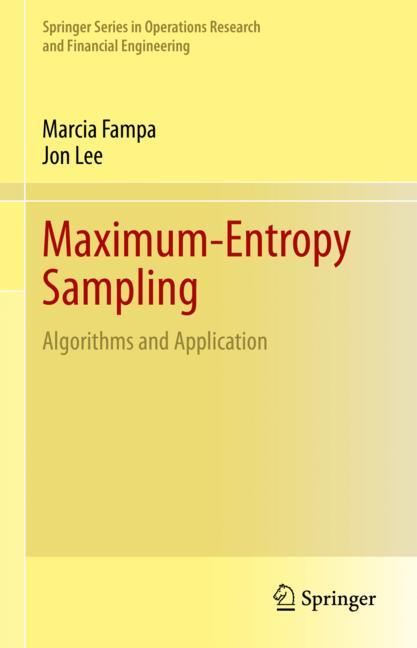
Maximum-Entropy Sampling
☆☆☆☆☆
(0 reviews)
Lowest price (incl. delivery)
13 727,00 JPY
Typical price676,04 PLN
Lowest (90 days)102,71 PLN
Offers3
Last updated2 小时前
Price history (90 days)
Full history
2026-08-08
2026-08-15
| 更新时间 | 价格 |
|---|---|
| 2026-08-08 | 102,71 |
| 2026-08-15 | 114,00 |
| 卖家 | Product price | Delivery | 总计 | 可用性 | Updated | |
|---|---|---|---|---|---|---|
| SP Springer Nature Author | 13 727,00 JPY | free | 13 727,00 JPY | 可购买 | 6 天前 | View offer |
| SP SpringerNatureLink Shop INT | 102,71 USD | free | 102,71 USD | 可购买 | 3 小时前 | View offer |
| SP SpringerNatureLink Shop INT | 114,00 EUR | 15,00 EUR | 129,00 EUR | 可购买 | 2 小时前 | View offer |
价格和库存可能会有变动。 最后更新: 15.08.2026 04:11.
EAN
9783031130786
Springer Nature
0,0
☆☆☆☆☆
0 reviews
5★
0%
4★
0%
3★
0%
2★
0%
1★
0%
Product reviews
No reviews yet — be the first!
This monograph presents a comprehensive treatment of the maximum-entropy sampling problem (MESP), which is a fascinating topic at the intersection of mathematical optimization and data science. The text situates MESP in information theory, as the algorithmic problem of calculating a sub-vector of pre-specificed size from a multivariate Gaussian random vector, so as to maximize Shannon's differential entropy. The text collects and expands on state-of-the-art algorithms for MESP, and addresses its application in the field of environmental monitoring. While MESP is a central optimization problem in the theory of statistical designs (particularly in the area of spatial monitoring), this book largely focuses on the unique challenges of its algorithmic side. From the perspective of mathematical-optimization methodology, MESP is rather unique (a 0/1 nonlinear program having a nonseparable objective function), and the algorithmic techniques employed are highly non-standard. In particular, successful techniques come from several disparate areas within the field of mathematical optimization; for example: convex optimization and duality, semidefinite programming, Lagrangian relaxation, dynamic programming, approximation algorithms, 0/1 optimization (e.g., branch-and-bound), extended formulation, and many aspects of matrix theory. The book is mainly aimed at graduate students and researchers in mathematical optimization and data analytics.
Similar products
 Good Practices and New Perspectives in Information Systems and Technologies
from $202.57
Good Practices and New Perspectives in Information Systems and Technologies
from $202.57
 2021 International Conference on Big Data Analytics for Cyber-Physical System in Smart City
from $202.57
2021 International Conference on Big Data Analytics for Cyber-Physical System in Smart City
from $202.57
 The Great Powers, and Iran's Social and Political Evolution
from $172.36
The Great Powers, and Iran's Social and Political Evolution
from $172.36
 Proceedings of the 3rd International Symposium on Disaster Resilience and Sustainable Development—Vo
from $202.57
Proceedings of the 3rd International Symposium on Disaster Resilience and Sustainable Development—Vo
from $202.57
 Processing and Fabrication of Advanced Materials, Volume 2
from $202.57
Processing and Fabrication of Advanced Materials, Volume 2
from $202.57
 Special Olympics Oral History Volume 4
from $172.36
Special Olympics Oral History Volume 4
from $172.36
 LGBTQI Inclusivity, Homosexuality, and Same-Sex Marriage in the Catholic Church
from $172.36
LGBTQI Inclusivity, Homosexuality, and Same-Sex Marriage in the Catholic Church
from $172.36
 Prediction and Performance in Geotechnical Engineering – Proceedings of the 9th Italian National Con
from $202.57
Prediction and Performance in Geotechnical Engineering – Proceedings of the 9th Italian National Con
from $202.57