
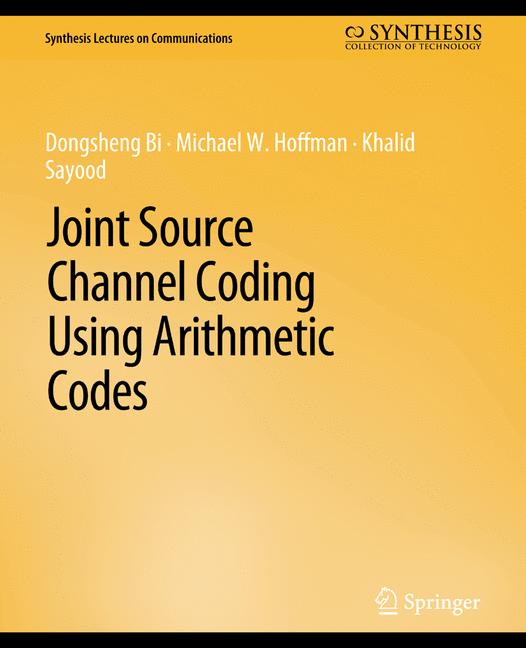
Joint Source Channel Coding Using Arithmetic Codes
☆☆☆☆☆
(0 reviews)
Lowest price (incl. delivery)
52,50 EUR
Typical price22,09 PLN
Lowest (90 days)21,39 PLN
Offers2
Last updated1 天前
| 卖家 | Product price | Delivery | 总计 | 可用性 | Updated | |
|---|---|---|---|---|---|---|
| SP SpringerNatureLink Shop INT | 23,50 EUR | 29,00 EUR | 52,50 EUR | 可购买 | 2 天前 | View offer |
| SP Springer Nature Author | 23,50 EUR | free | 23,50 EUR | 可购买 | 1 天前 | View offer |
价格和库存可能会有变动。 最后更新: 08.08.2026 20:07.
EAN
9783031016752
Springer Nature
0,0
☆☆☆☆☆
0 reviews
5★
0%
4★
0%
3★
0%
2★
0%
1★
0%
Product reviews
No reviews yet — be the first!
Based on the encoding process, arithmetic codes can be viewed as tree codes and current proposals for decoding arithmetic codes with forbidden symbols belong to sequential decoding algorithms and their variants. In this monograph, we propose a new way of looking at arithmetic codes with forbidden symbols. If a limit is imposed on the maximum value of a key parameter in the encoder, this modified arithmetic encoder can also be modeled as a finite state machine and the code generated can be treated as a variable-length trellis code. The number of states used can be reduced and techniques used for decoding convolutional codes, such as the list Viterbi decoding algorithm, can be applied directly on the trellis. The finite state machine interpretation can be easily migrated to Markov source case. We can encode Markov sources without considering the conditional probabilities, while using the list Viterbi decoding algorithm which utilizes the conditional probabilities. We can also use context-based arithmetic coding to exploit the conditional probabilities of the Markov source and apply a finite state machine interpretation to this problem. The finite state machine interpretation also allows us to more systematically understand arithmetic codes with forbidden symbols. It allows us to find the partial distance spectrum of arithmetic codes with forbidden symbols. We also propose arithmetic codes with memories which use high memory but low implementation precision arithmetic codes. The low implementation precision results in a state machine with less complexity. The introduced input memories allow us to switch the probability functions used for arithmetic coding. Combining these two methods give us a huge parameter space of the arithmetic codes with forbidden symbols. Hence we can choose codes with better distance properties while maintaining the encoding efficiency and decoding complexity. A construction and search method is proposed and simulation results show that we can achieve a similar performance as turbo codes when we apply this approach to rate 2/3 arithmetic codes. Table of Contents: Introduction / Arithmetic Codes / Arithmetic Codes with Forbidden Symbols / Distance Property and Code Construction / Conclusion
Similar products
 Patient Safety Coaching
from $91.97
Patient Safety Coaching
from $91.97
 Ethnography and Diversity
from $69.30
Ethnography and Diversity
from $69.30
 Smart Villages
from $91.97
Smart Villages
from $91.97
 Nuclear Non-Proliferation in International Law - Volume VI
from $91.97
Nuclear Non-Proliferation in International Law - Volume VI
from $91.97
 The Price of Freedom
from $91.97
The Price of Freedom
from $91.97
 Eco-Social Policy in the OECD and the World Bank
from $91.97
Eco-Social Policy in the OECD and the World Bank
from $91.97
 Special Topics in Policing
from $122.58
Special Topics in Policing
from $122.58
 Music from the Heart
from $91.97
Music from the Heart
from $91.97