
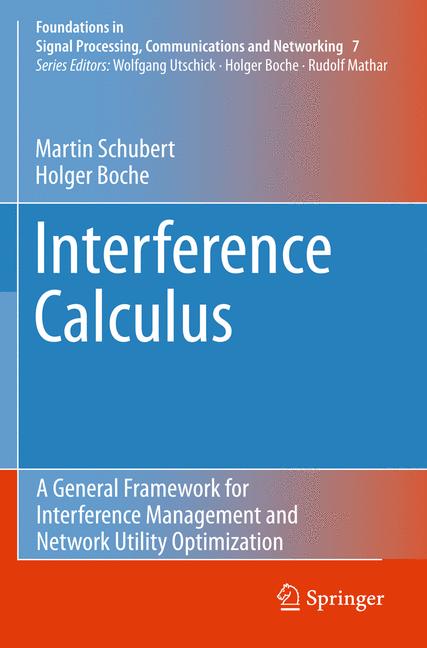
Interference Calculus
☆☆☆☆☆
(0 reviews)
Lowest price (incl. delivery)
14 299,00 JPY
Typical price658,93 PLN
Lowest (90 days)84,99 PLN
Offers2
Last updated1 天前
| 卖家 | Product price | Delivery | 总计 | 可用性 | Updated | |
|---|---|---|---|---|---|---|
| SP Springer Nature Author | 14 299,00 JPY | free | 14 299,00 JPY | 可购买 | 1 天前 | View offer |
| SP SpringerNatureLink Shop INT | 109,99 USD | 19,00 USD | 128,99 USD | 可购买 | 1 天前 | View offer |
价格和库存可能会有变动。 最后更新: 08.08.2026 23:21.
0,0
☆☆☆☆☆
0 reviews
5★
0%
4★
0%
3★
0%
2★
0%
1★
0%
Product reviews
No reviews yet — be the first!
This book develops a mathematical framework for modeling and optimizing interference-coupled multiuser systems. At the core of this framework is the concept of general interference functions, which provides a simple means of characterizing interdependencies between users. The entire analysis builds on the two core axioms scale-invariance and monotonicity. The proposed network calculus has its roots in power control theory and wireless communications. It adds theoretical tools for analyzing the typical behavior of interference-coupled networks. In this way it complements existing game-theoretic approaches. The framework should also be viewed in conjunction with optimization theory. There is a fruitful interplay between the theory of interference functions and convex optimization theory. By jointly exploiting the properties of interference functions, it is possible to design algorithms that outperform general-purpose techniques that only exploit convexity. The title “network calculus” refers to the fact that the theory of interference functions constitutes a generic theoretical framework for the analysis of interference coupled systems. Certain operations within the framework are “closed”, that is, combinations of interference functions are interference functions again. Also, certain properties are preserved under such operations. This, provides a methodology for analyzing different multiuser performance measures that can be expressed as interference functions or combinations of interference functions.
Similar products
 Patient Safety Coaching
from $91.97
Patient Safety Coaching
from $91.97
 Ethnography and Diversity
from $69.30
Ethnography and Diversity
from $69.30
 Smart Villages
from $91.97
Smart Villages
from $91.97
 Nuclear Non-Proliferation in International Law - Volume VI
from $91.97
Nuclear Non-Proliferation in International Law - Volume VI
from $91.97
 The Price of Freedom
from $91.97
The Price of Freedom
from $91.97
 Eco-Social Policy in the OECD and the World Bank
from $91.97
Eco-Social Policy in the OECD and the World Bank
from $91.97
 Special Topics in Policing
from $122.58
Special Topics in Policing
from $122.58
 Music from the Heart
from $91.97
Music from the Heart
from $91.97