
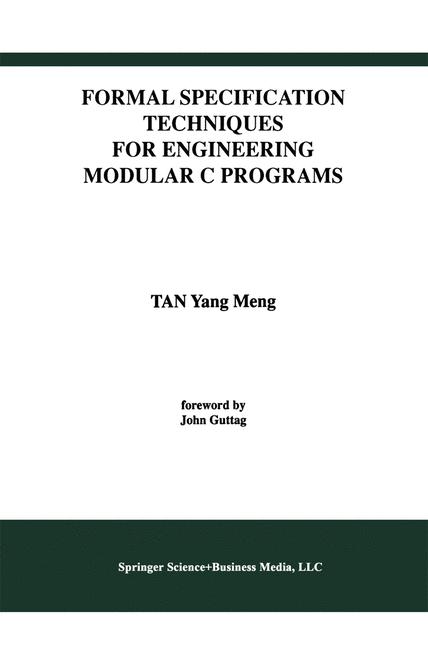
Formal Specification Techniques for Engineering Modular C Programs
☆☆☆☆☆
(0 reviews)
Lowest price (incl. delivery)
21 474,00 JPY
Typical price2 864,19 PLN
Lowest (90 days)129,99 PLN
Offers6
Last updated1 周前
Price history (90 days)
Full history
2026-08-08
2026-08-15
| 更新时间 | 价格 |
|---|---|
| 2026-08-08 | 129,99 |
| 2026-08-15 | 155,99 |
| 卖家 | Product price | Delivery | 总计 | 可用性 | Updated | |
|---|---|---|---|---|---|---|
| SP SpringerNatureLink Shop INT | 21 449,00 JPY | 25,00 JPY | 21 474,00 JPY | 可购买 | 2 天前 | View offer |
| SP Springer Nature Author | 21 449,00 JPY | free | 21 449,00 JPY | 可购买 | 1 周前 | View offer |
| SP SpringerNatureLink Shop INT | 149,99 USD | 29,00 USD | 178,99 USD | 可购买 | 2 天前 | View offer |
| SP SpringerNatureLink Shop INT | 169,99 USD | 15,00 USD | 184,99 USD | 可购买 | 2 天前 | View offer |
| SP SpringerNatureLink Shop INT | 169,99 USD | 19,00 USD | 188,99 USD | 可购买 | 2 天前 | View offer |
| SP SpringerNatureLink Shop INT | 177,00 EUR | 19,00 EUR | 196,00 EUR | 可购买 | 2 天前 | View offer |
价格和库存可能会有变动。 最后更新: 08.08.2026 23:33.
0,0
☆☆☆☆☆
0 reviews
5★
0%
4★
0%
3★
0%
2★
0%
1★
0%
Product reviews
No reviews yet — be the first!
Software is difficult to develop, maintain, and reuse. Two factors that contribute to this difficulty are the lack of modular design and good program documentation. The first makes software changes more difficult to implement. The second makes programs more difficult to understand and to maintain. Formal Specification Techniques for Engineering Modular C Programs describes a novel approach to promoting program modularity. The book presents a formal specification language that promotes software modularity through the use of abstract data types, even though the underlying programming language may not have such support. This language is structured to allow useful information to be extracted from a specification, which is then used to perform consistency checks between the specification and its implementation. Formal Specification Techniques for Engineering Modular C Programs also describes a specification-driven, software re-engineering process model for improving existing programs. The aim of this process is to make existing programs easier to maintain and reuse while keeping their essential functionalities unchanged. Audience: Suitable as a secondary text for graduate level courses in software engineering, and as a reference for researchers and practitioners in industry.
Similar products
 50 Years of Philosophy and Medicine
from $107.30
50 Years of Philosophy and Medicine
from $107.30
 Understanding Cybersecurity Law and Digital Privacy
from $122.63
Understanding Cybersecurity Law and Digital Privacy
from $122.63
 Decisions in International Trade and Logistics
from $122.63
Decisions in International Trade and Logistics
from $122.63
 Advances in Economic Measurement
from $122.63
Advances in Economic Measurement
from $122.63
 Nanomaterials
from $137.96
Nanomaterials
from $137.96
 Sustainable Scaffolds-based Strategies in Tissue Engineering and Regenerative Medicine
from $162.87
Sustainable Scaffolds-based Strategies in Tissue Engineering and Regenerative Medicine
from $162.87
 Narratives in Educational Research
from $162.87
Narratives in Educational Research
from $162.87
 Environmental Biology of the Young Chinese Sturgeon
from $210.78
Environmental Biology of the Young Chinese Sturgeon
from $210.78