
Contextual Intelligence
☆☆☆☆☆
(0 reviews)
Lowest price (incl. delivery)
61,50 EUR
Typical price36,76 PLN
Lowest (90 days)31,99 PLN
Offers2
Last updated1 周前
Price history (90 days)
Full history
2026-08-08
2026-08-14
| 更新时间 | 价格 |
|---|---|
| 2026-08-08 | 31,99 |
| 2026-08-14 | 31,99 |
| 卖家 | Product price | Delivery | 总计 | 可用性 | Updated | |
|---|---|---|---|---|---|---|
| SP SpringerNatureLink Shop INT | 42,50 EUR | 19,00 EUR | 61,50 EUR | 可购买 | 5 天前 | View offer |
| SP Springer Nature Author | 42,50 EUR | 29,00 EUR | 71,50 EUR | 可购买 | 1 周前 | View offer |
价格和库存可能会有变动。 最后更新: 08.08.2026 20:17.
EAN
9783319449982
Springer Nature
0,0
☆☆☆☆☆
0 reviews
5★
0%
4★
0%
3★
0%
2★
0%
1★
0%
Product reviews
No reviews yet — be the first!
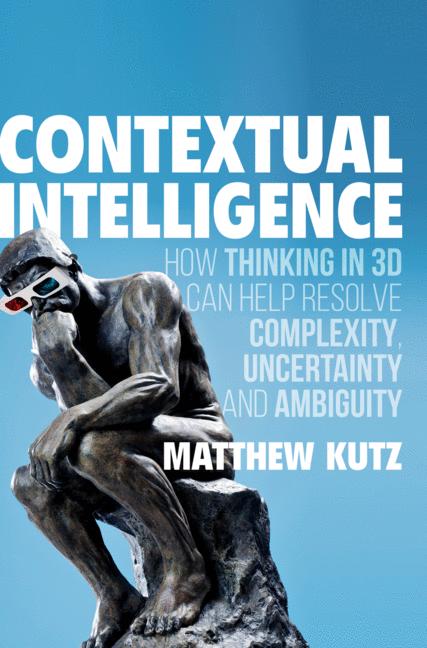
This book offers a structured framework for critical thinking and decision making that shows how to use hindsight, insight, and foresight to navigate through complexity. Every organization and every person faces rapid change and complexity. Contextual intelligence – understanding fully the context in which one is operating – teaches the reader how to navigate that complexity and respond appropriately in the face of change (expected and unexpected). The Three-Dimensional (3D) Thinking™ framework helps structure critical thinking by showing how to appropriately bring past experience, present intuition, and future ambiguity– in other words: hindsight, insight, and foresight – to bear on any given problem. Kutz offers a way to rationally organize difficult concepts such as complexity, tacit knowledge, and synchronicity into usable and understandable language, but more importantly teaches the reader how to apply these concepts in a very practical and meaningful way with measurable and tangible outcomes. The book also describes in detail 12 behaviors associated with contextual intelligence. Four behaviors are associated with hindsight, four behaviors are associated with insight, and four behaviors are associated with foresight. The book takes the reader through the 12 behaviors and how they relate to 3D Thinking. Cases and anecdotes are used generously to provide examples. Chapters are followed by critical thinking questions and questions related to the cases in the chapters. Furthermore, questions and practical tools are introduced that help the reader assess and determine their level of contextual intelligence.
Similar products
 50 Years of Philosophy and Medicine
from $107.30
50 Years of Philosophy and Medicine
from $107.30
 Understanding Cybersecurity Law and Digital Privacy
from $122.63
Understanding Cybersecurity Law and Digital Privacy
from $122.63
 Decisions in International Trade and Logistics
from $122.63
Decisions in International Trade and Logistics
from $122.63
 Advances in Economic Measurement
from $122.63
Advances in Economic Measurement
from $122.63
 Nanomaterials
from $137.96
Nanomaterials
from $137.96
 Sustainable Scaffolds-based Strategies in Tissue Engineering and Regenerative Medicine
from $162.87
Sustainable Scaffolds-based Strategies in Tissue Engineering and Regenerative Medicine
from $162.87
 Narratives in Educational Research
from $162.87
Narratives in Educational Research
from $162.87
 Environmental Biology of the Young Chinese Sturgeon
from $210.78
Environmental Biology of the Young Chinese Sturgeon
from $210.78