
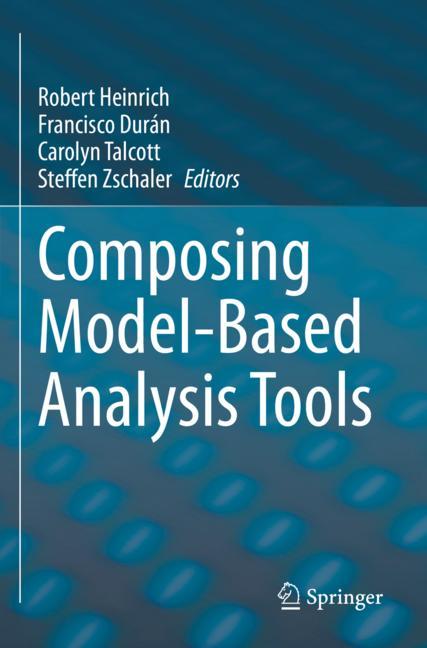
Composing Model-Based Analysis Tools
☆☆☆☆☆
(0 reviews)
Lowest price (incl. delivery)
134,99 EUR
Typical price1 048,29 PLN
Lowest (90 days)84,99 PLN
Offers2
Last updated7 小时前
| 卖家 | Product price | Delivery | 总计 | 可用性 | Updated | |
|---|---|---|---|---|---|---|
| SP SpringerNatureLink Shop INT | 109,99 EUR | 25,00 EUR | 134,99 EUR | 可购买 | 16 小时前 | View offer |
| SP Springer Nature Author | 20 019,00 JPY | free | 20 019,00 JPY | 可购买 | 7 小时前 | View offer |
价格和库存可能会有变动。 最后更新: 08.08.2026 23:20.
0,0
☆☆☆☆☆
0 reviews
5★
0%
4★
0%
3★
0%
2★
0%
1★
0%
Product reviews
No reviews yet — be the first!
This book presents joint works of members of the software engineering and formal methods communities with representatives from industry, with the goal of establishing the foundations for a common understanding of the needs for more flexibility in model-driven engineering. It is based on the Dagstuhl Seminar 19481 „Composing Model-Based Analysis Tools“, which was held November 24 to 29, 2019, at Schloss Dagstuhl, Germany, where current challenges, their background and concepts to address them were discussed. The book is structured in two parts, and organized around five fundamental core aspects of the subject: (1) the composition of languages, models and analyses; (2) the integration and orchestration of analysis tools; (3) the continual analysis of models; (4) the exploitation of results; and (5) the way to handle uncertainty in model-based developments. After a chapter on foundations and common terminology and a chapter on challenges in the field, one chapter is devoted toeach of the above five core aspects in the first part of the book. These core chapters are accompanied by additional case studies in the second part of the book, in which specific tools and experiences are presented in more detail to illustrate the concepts and ideas previously introduced. The book mainly targets researchers in the fields of software engineering and formal methods as well as software engineers from industry with basic familiarity with quality properties, model-driven engineering and analysis tools. From reading the book, researchers will receive an overview of the state-of-the-art and current challenges, research directions, and recent concepts, while practitioners will be interested to learn about concrete tools and practical applications in the context of case studies.
Similar products
 Patient Safety Coaching
from $91.97
Patient Safety Coaching
from $91.97
 Ethnography and Diversity
from $69.30
Ethnography and Diversity
from $69.30
 Smart Villages
from $91.97
Smart Villages
from $91.97
 Nuclear Non-Proliferation in International Law - Volume VI
from $91.97
Nuclear Non-Proliferation in International Law - Volume VI
from $91.97
 The Price of Freedom
from $91.97
The Price of Freedom
from $91.97
 Eco-Social Policy in the OECD and the World Bank
from $91.97
Eco-Social Policy in the OECD and the World Bank
from $91.97
 Special Topics in Policing
from $122.58
Special Topics in Policing
from $122.58
 Music from the Heart
from $91.97
Music from the Heart
from $91.97