
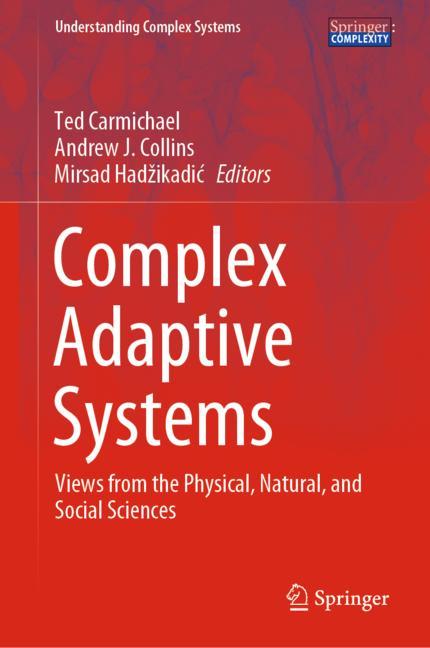
Complex Adaptive Systems
☆☆☆☆☆
(0 reviews)
Lowest price (incl. delivery)
24 309,00 JPY
Typical price1 205,96 PLN
Lowest (90 days)56,70 PLN
Offers4
Last updated1 周前
Price history (90 days)
Full history
2026-08-08
2026-08-15
| 更新时间 | 价格 |
|---|---|
| 2026-08-08 | 56,70 |
| 2026-08-15 | 185,29 |
| 卖家 | Product price | Delivery | 总计 | 可用性 | Updated | |
|---|---|---|---|---|---|---|
| SP SpringerNatureLink Shop INT | 24 309,00 JPY | free | 24 309,00 JPY | 可购买 | 2 天前 | View offer |
| SP Springer Nature Author | 24 309,00 JPY | free | 24 309,00 JPY | 可购买 | 1 周前 | View offer |
| SP SpringerNatureLink Shop INT | 201,00 EUR | 25,00 EUR | 226,00 EUR | 可购买 | 2 天前 | View offer |
| VI VitalSource | 1 075,87 ZAR | 19,00 ZAR | 1 094,87 ZAR | 可购买 | 1 周前 | View offer |
价格和库存可能会有变动。 最后更新: 08.08.2026 06:35.
EAN
9783030203078
Springer Nature
0,0
☆☆☆☆☆
0 reviews
5★
0%
4★
0%
3★
0%
2★
0%
1★
0%
Product reviews
No reviews yet — be the first!
This book emerged out of international conferences organized as part of the AAAI Fall Symposia series, and the Swarmfest 2017 conference. It brings together researchers from diverse fields studying these complex systems using CAS and agent-based modeling tools and techniques. In the past, the knowledge gained in each domain has largely remained exclusive to that domain. By bringing together scholars who study these phenomena, the book takes knowledge from one domain to provide insight into others. Most interesting phenomena in natural and social systems include constant transitions and oscillations among their various phases – wars, companies, societies, markets, and humans rarely stay in a stable, predictable state for long. Randomness, power laws, and human behavior ensure that the future is both unknown and challenging. How do events unfold? When do they take hold? Why do some initial events cause an avalanche while others do not? What characterizes these events? What are the thresholds that differentiate a sea change from a non-event? Complex adaptive systems (CAS) have proven to be a powerful tool for exploring these and other related phenomena. The authors characterize a general CAS model as having a large number of self-similar agents that: 1) utilize one or more levels of feedback; 2) exhibit emergent properties and self-organization; and 3) produce non-linear dynamic behavior. Advances in modeling and computing technology have led not only to a deeper understanding of complex systems in many areas, but they have also raised the possibility that similar fundamental principles may be at work across these systems, even though the underlying principles may manifest themselves differently.
Similar products
 50 Years of Philosophy and Medicine
from $107.30
50 Years of Philosophy and Medicine
from $107.30
 Understanding Cybersecurity Law and Digital Privacy
from $122.63
Understanding Cybersecurity Law and Digital Privacy
from $122.63
 Decisions in International Trade and Logistics
from $122.63
Decisions in International Trade and Logistics
from $122.63
 Advances in Economic Measurement
from $122.63
Advances in Economic Measurement
from $122.63
 Nanomaterials
from $137.96
Nanomaterials
from $137.96
 Sustainable Scaffolds-based Strategies in Tissue Engineering and Regenerative Medicine
from $162.87
Sustainable Scaffolds-based Strategies in Tissue Engineering and Regenerative Medicine
from $162.87
 Narratives in Educational Research
from $162.87
Narratives in Educational Research
from $162.87
 Environmental Biology of the Young Chinese Sturgeon
from $210.78
Environmental Biology of the Young Chinese Sturgeon
from $210.78