
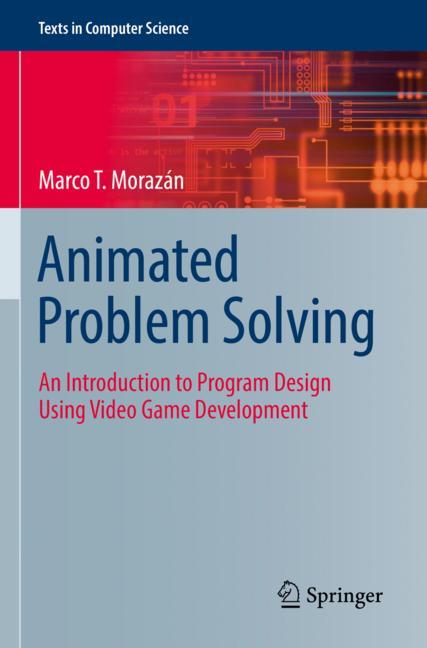
Animated Problem Solving
☆☆☆☆☆
(0 reviews)
Lowest price (incl. delivery)
8 579,00 JPY
Typical price1 479,78 PLN
Lowest (90 days)44,93 PLN
Offers2
Last updated16 小时前
| 卖家 | Product price | Delivery | 总计 | 可用性 | Updated | |
|---|---|---|---|---|---|---|
| SP Springer Nature Author | 8 579,00 JPY | free | 8 579,00 JPY | 可购买 | 14 小时前 | View offer |
| SP SpringerNatureLink Shop INT | 65,99 EUR | free | 65,99 EUR | 可购买 | 1 天前 | View offer |
价格和库存可能会有变动。 最后更新: 08.08.2026 21:09.
EAN
9783030850937
Springer Nature
0,0
☆☆☆☆☆
0 reviews
5★
0%
4★
0%
3★
0%
2★
0%
1★
0%
Product reviews
No reviews yet — be the first!
This textbook is about systematic problem solving and systematic reasoning using type-driven design. There are two problem solving techniques that are emphasized throughout the book: divide and conquer and iterative refinement. Divide and conquer is the process by which a large problem is broken into two or more smaller problems that are easier to solve and then the solutions for the smaller pieces are combined to create an answer to the problem. Iterative refinement is the process by which a solution to a problem is gradually made better–like the drafts of an essay. Mastering these techniques are essential to becoming a good problem solver and programmer. The book is divided in five parts. Part I focuses on the basics. It starts with how to write expressions and subsequently leads to decision making and functions as the basis for problem solving. Part II then introduces compound data of finite size, while Part III covers compound data of arbitrarysize like e.g. lists, intervals, natural numbers, and binary trees. It also introduces structural recursion, a powerful data-processing strategy that uses divide and conquer to process data whose size is not fixed. Next, Part IV delves into abstraction and shows how to eliminate repetitions in solutions to problems. It also introduces generic programming which is abstraction over the type of data processed. This leads to the realization that functions are data and, perhaps more surprising, that data are functions, which in turn naturally leads to object-oriented programming. Part V introduces distributed programming, i.e., using multiple computers to solve a problem. This book promises that by the end of it readers will have designed and implemented a multiplayer video game that they can play with their friends over the internet. To achieve this, however, there is a lot about problem solving and programming that must be learned first. The game is developed using iterative refinement. The reader learns step-by-step about programming and how to apply new knowledge to develop increasingly better versions of the video game. This way, readers practice modern trends that are likely to be common throughout a professional career and beyond.
Similar products
 Patient Safety Coaching
from $91.97
Patient Safety Coaching
from $91.97
 Ethnography and Diversity
from $69.30
Ethnography and Diversity
from $69.30
 Smart Villages
from $91.97
Smart Villages
from $91.97
 Nuclear Non-Proliferation in International Law - Volume VI
from $91.97
Nuclear Non-Proliferation in International Law - Volume VI
from $91.97
 The Price of Freedom
from $91.97
The Price of Freedom
from $91.97
 Eco-Social Policy in the OECD and the World Bank
from $91.97
Eco-Social Policy in the OECD and the World Bank
from $91.97
 Special Topics in Policing
from $122.58
Special Topics in Policing
from $122.58
 Music from the Heart
from $91.97
Music from the Heart
from $91.97