
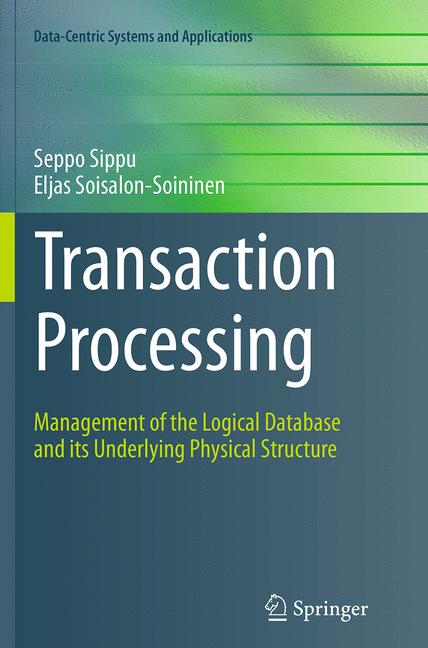
Transaction Processing
☆☆☆☆☆
(0 reviews)
Lowest price (incl. delivery)
8 608,00 JPY
Typical price1 958,18 PLN
Lowest (90 days)62,39 PLN
Offers2
Last updated13 giờ trước
| Người bán | Product price | Delivery | Tổng cộng | Tình trạng | Updated | |
|---|---|---|---|---|---|---|
| SP Springer Nature Author | 8 579,00 JPY | 29,00 JPY | 8 608,00 JPY | Có sẵn | 13 giờ trước | View offer |
| SP SpringerNatureLink Shop INT | 65,99 EUR | 19,00 EUR | 84,99 EUR | Có sẵn | 1 ngày trước | View offer |
Giá và tình trạng có thể thay đổi. Cập nhật lần cuối: 08.08.2026 23:17.
EAN
9783319353579
Springer Nature
0,0
☆☆☆☆☆
0 reviews
5★
0%
4★
0%
3★
0%
2★
0%
1★
0%
Product reviews
No reviews yet — be the first!
Transactions are a concept related to the logical database as seen from the perspective of database application programmers: a transaction is a sequence of database actions that is to be executed as an atomic unit of work. The processing of transactions on databases is a well- established area with many of its foundations having already been laid in the late 1970s and early 1980s. The unique feature of this textbook is that it bridges the gap between the theory of transactions on the logical database and the implementation of the related actions on the underlying physical database. The authors relate the logical database, which is composed of a dynamically changing set of data items with unique keys, and the underlying physical database with a set of fixed-size data and index pages on disk. Their treatment of transaction processing builds on the “do-redo-undo” recovery paradigm, and all methods and algorithms presented are carefully designed to be compatible with this paradigm as well as with write-ahead logging, steal-and-no-force buffering, and fine-grained concurrency control. Chapters 1 to 6 address the basics needed to fully appreciate transaction processing on a centralized database system within the context of our transaction model, covering topics like ACID properties, database integrity, buffering, rollbacks, isolation, and the interplay of logical locks and physical latches. Chapters 7 and 8 present advanced features including deadlock-free algorithms for reading, inserting and deleting tuples, while the remaining chapters cover additional advanced topics extending on the preceding foundational chapters, including multi-granular locking, bulk actions, versioning, distributed updates, and write-intensive transactions. This book is primarily intended as a text for advanced undergraduate or graduate courses on database management in general or transaction processing in particular.
Similar products
 Patient Safety Coaching
from $91.97
Patient Safety Coaching
from $91.97
 Ethnography and Diversity
from $69.30
Ethnography and Diversity
from $69.30
 Smart Villages
from $91.97
Smart Villages
from $91.97
 Nuclear Non-Proliferation in International Law - Volume VI
from $91.97
Nuclear Non-Proliferation in International Law - Volume VI
from $91.97
 The Price of Freedom
from $91.97
The Price of Freedom
from $91.97
 Eco-Social Policy in the OECD and the World Bank
from $91.97
Eco-Social Policy in the OECD and the World Bank
from $91.97
 Special Topics in Policing
from $122.58
Special Topics in Policing
from $122.58
 Music from the Heart
from $91.97
Music from the Heart
from $91.97