
The Implicit Function Theorem
☆☆☆☆☆
(0 reviews)
Lowest price (incl. delivery)
7 216,00 JPY
Typical price413,32 PLN
Lowest (90 days)52,99 PLN
Offers2
Last updated5 giờ trước
| Người bán | Product price | Delivery | Tổng cộng | Tình trạng | Updated | |
|---|---|---|---|---|---|---|
| SP Springer Nature Author | 7 201,00 JPY | 15,00 JPY | 7 216,00 JPY | Có sẵn | 5 giờ trước | View offer |
| SP SpringerNatureLink Shop INT | 72,50 EUR | 19,00 EUR | 91,50 EUR | Có sẵn | 17 giờ trước | View offer |
Giá và tình trạng có thể thay đổi. Cập nhật lần cuối: 08.08.2026 23:15.
EAN
9781461200598
Springer Nature
0,0
☆☆☆☆☆
0 reviews
5★
0%
4★
0%
3★
0%
2★
0%
1★
0%
Product reviews
No reviews yet — be the first!
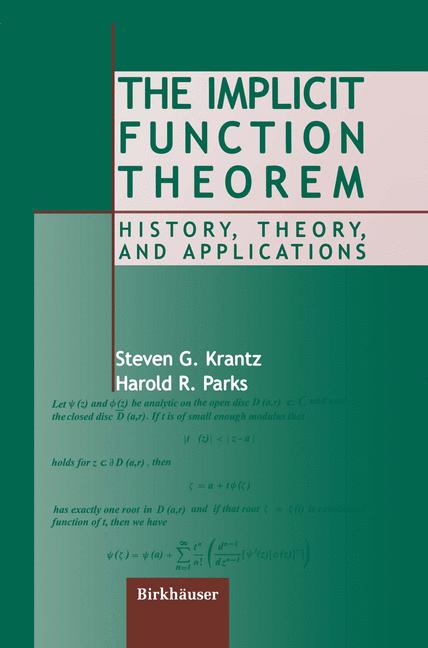
The implicit function theorem is part of the bedrock of mathematical analysis and geometry. Finding its genesis in eighteenth century studies of real analytic functions and mechanics, the implicit and inverse function theorems have now blossomed into powerful tools in the theories of partial differential equations, differential geometry, and geometric analysis. There are many different forms of the implicit function theorem, including (i) the classical formulation for C^k functions, (ii) formulations in other function spaces, (iii) formulations for non- smooth functions, (iv) formulations for functions with degenerate Jacobian. Particularly powerful implicit function theorems, such as the Nash--Moser theorem, have been developed for specific applications (e.g., the imbedding of Riemannian manifolds). All of these topics, and many more, are treated in the present volume. The history of the implicit function theorem is a lively and complex story, and is intimately bound up with the development of fundamental ideas in analysis and geometry. This entire development, together with mathematical examples and proofs, is recounted for the first time here. It is an exciting tale, and it continues to evolve. "The Implicit Function Theorem" is an accessible and thorough treatment of implicit and inverse function theorems and their applications. It will be of interest to mathematicians, graduate/advanced undergraduate students, and to those who apply mathematics. The book unifies disparate ideas that have played an important role in modern mathematics. It serves to document and place in context a substantial body of mathematical ideas.
Similar products
 Patient Safety Coaching
from $91.97
Patient Safety Coaching
from $91.97
 Ethnography and Diversity
from $69.30
Ethnography and Diversity
from $69.30
 Smart Villages
from $91.97
Smart Villages
from $91.97
 Nuclear Non-Proliferation in International Law - Volume VI
from $91.97
Nuclear Non-Proliferation in International Law - Volume VI
from $91.97
 The Price of Freedom
from $91.97
The Price of Freedom
from $91.97
 Eco-Social Policy in the OECD and the World Bank
from $91.97
Eco-Social Policy in the OECD and the World Bank
from $91.97
 Special Topics in Policing
from $122.58
Special Topics in Policing
from $122.58
 Music from the Heart
from $91.97
Music from the Heart
from $91.97