
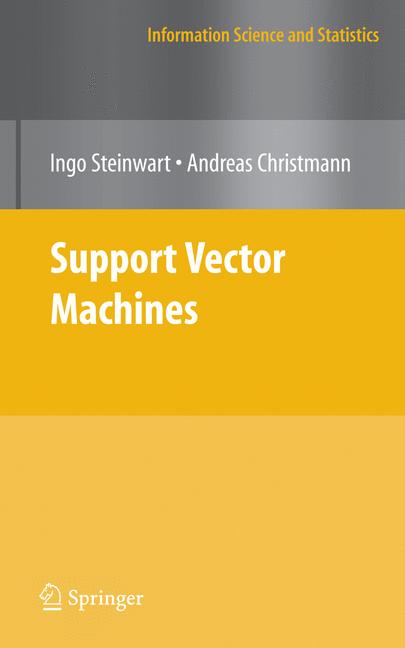
Support Vector Machines
☆☆☆☆☆
(0 reviews)
Lowest price (incl. delivery)
18 904,00 JPY
Typical price3 273,00 PLN
Lowest (90 days)139,00 PLN
Offers3
Last updated1 tuần trước
Price history (90 days)
Full history
2026-08-08
2026-08-15
| Cập nhật lúc | Giá |
|---|---|
| 2026-08-08 | 139,00 |
| 2026-08-15 | 156,00 |
| Người bán | Product price | Delivery | Tổng cộng | Tình trạng | Updated | |
|---|---|---|---|---|---|---|
| SP SpringerNatureLink Shop INT | 18 875,00 JPY | 29,00 JPY | 18 904,00 JPY | Có sẵn | 5 ngày trước | View offer |
| SP Springer Nature Author | 18 875,00 JPY | free | 18 875,00 JPY | Có sẵn | 1 tuần trước | View offer |
| SP SpringerNatureLink Shop INT | 156,00 EUR | 29,00 EUR | 185,00 EUR | Có sẵn | 5 ngày trước | View offer |
Giá và tình trạng có thể thay đổi. Cập nhật lần cuối: 08.08.2026 23:32.
EAN
9780387772424
Springer Nature
0,0
☆☆☆☆☆
0 reviews
5★
0%
4★
0%
3★
0%
2★
0%
1★
0%
Product reviews
No reviews yet — be the first!
Every mathematical discipline goes through three periods of development: the naive, the formal, and the critical. David Hilbert The goal of this book is to explain the principles that made support vector machines (SVMs) a successful modeling and prediction tool for a variety of applications. We try to achieve this by presenting the basic ideas of SVMs together with the latest developments and current research questions in a uni?ed style. In a nutshell, we identify at least three reasons for the success of SVMs: their ability to learn well with only a very small number of free parameters, their robustness against several types of model violations and outliers, and last but not least their computational e?ciency compared with several other methods. Although there are several roots and precursors of SVMs, these methods gained particular momentum during the last 15 years since Vapnik (1995, 1998) published his well-known textbooks on statistical learning theory with aspecialemphasisonsupportvectormachines. Sincethen,the?eldofmachine learninghaswitnessedintenseactivityinthestudyofSVMs,whichhasspread moreandmoretootherdisciplinessuchasstatisticsandmathematics. Thusit seems fair to say that several communities are currently working on support vector machines and on related kernel-based methods. Although there are many interactions between these communities, we think that there is still roomforadditionalfruitfulinteractionandwouldbegladifthistextbookwere found helpful in stimulating further research. Many of the results presented in this book have previously been scattered in the journal literature or are still under review. As a consequence, these results have been accessible only to a relativelysmallnumberofspecialists,sometimesprobablyonlytopeoplefrom one community but not the others.
Similar products
 50 Years of Philosophy and Medicine
from $107.30
50 Years of Philosophy and Medicine
from $107.30
 Understanding Cybersecurity Law and Digital Privacy
from $122.63
Understanding Cybersecurity Law and Digital Privacy
from $122.63
 Decisions in International Trade and Logistics
from $122.63
Decisions in International Trade and Logistics
from $122.63
 Advances in Economic Measurement
from $122.63
Advances in Economic Measurement
from $122.63
 Nanomaterials
from $137.96
Nanomaterials
from $137.96
 Sustainable Scaffolds-based Strategies in Tissue Engineering and Regenerative Medicine
from $162.87
Sustainable Scaffolds-based Strategies in Tissue Engineering and Regenerative Medicine
from $162.87
 Narratives in Educational Research
from $162.87
Narratives in Educational Research
from $162.87
 Environmental Biology of the Young Chinese Sturgeon
from $210.78
Environmental Biology of the Young Chinese Sturgeon
from $210.78