
Robot Dynamics Algorithms
☆☆☆☆☆
(0 reviews)
Lowest price (incl. delivery)
29,95 USD
Typical price454,15 PLN
Lowest (90 days)25,19 PLN
Offers7
Last updated1 tuần trước
Price history (90 days)
Full history
2026-08-08
2026-08-15
| Cập nhật lúc | Giá |
|---|---|
| 2026-08-08 | 27,99 |
| 2026-08-14 | 25,19 |
| 2026-08-15 | 37,44 |
| Người bán | Product price | Delivery | Tổng cộng | Tình trạng | Updated | |
|---|---|---|---|---|---|---|
| SP SpringerNatureLink Shop INT | 29,95 USD | free | 29,95 USD | Có sẵn | 3 ngày trước | View offer |
| SP SpringerNatureLink Shop INT | 34,99 USD | 29,00 USD | 63,99 USD | Có sẵn | 3 ngày trước | View offer |
| SP SpringerNatureLink Shop INT | 38,49 USD | free | 38,49 USD | Có sẵn | 3 ngày trước | View offer |
| SP SpringerNatureLink Shop INT | 38,49 USD | free | 38,49 USD | Có sẵn | 3 ngày trước | View offer |
| SP SpringerNatureLink Shop INT | 41,30 EUR | free | 41,30 EUR | Có sẵn | 3 ngày trước | View offer |
| SP SpringerNatureLink Shop INT | 7 149,00 JPY | 29,00 JPY | 7 178,00 JPY | Có sẵn | 3 ngày trước | View offer |
| SP Springer Nature Author | 7 149,00 JPY | free | 7 149,00 JPY | Có sẵn | 1 tuần trước | View offer |
Giá và tình trạng có thể thay đổi. Cập nhật lần cuối: 08.08.2026 10:41.
0,0
☆☆☆☆☆
0 reviews
5★
0%
4★
0%
3★
0%
2★
0%
1★
0%
Product reviews
No reviews yet — be the first!
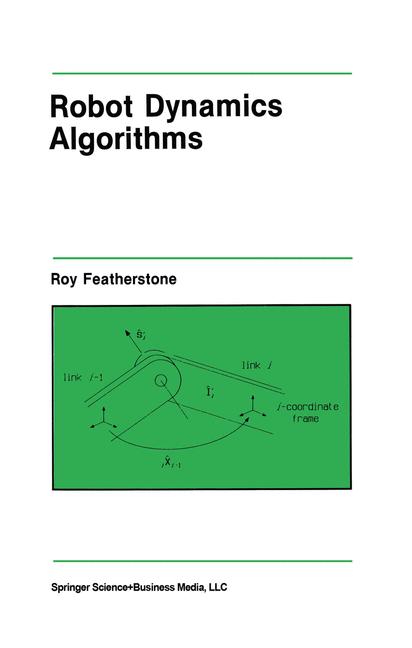
The purpose of this book is to present computationally efficient algorithms for calculating the dynamics of robot mechanisms represented as systems of rigid bodies. The efficiency is achieved by the use of recursive formulations of the equations of motion, i.e. formulations in which the equations of motion are expressed implicitly in terms of recurrence relations between the quantities describing the system. The use of recursive formulations in dynamics is fairly new, 50 the principles of their operation and reasons for their efficiency are explained. Three main algorithms are described: the recursIve Newton-Euler formulation for inverse dynamics (the calculation of the forces given the accelerations), and the composite-rigid-body and articulated-body methods for forward dynamics (the calculation of the accelerations given the forces). These algorithms are initially described in terms of an un-branched, open loop kinematic chain -- a typical serial robot mechanism. This is done to keep the descriptions of the algorithms simple, and is in line with descriptions appearing in the literature. Once the basic algorithms have been introduced, the restrictions on the mechanism are lifted and the algorithms are extended to cope with kinematic trees and loops, and general constraints at the joints. The problem of simulating the effect of contact between a robot and its environment is also considered. Some consideration is given to the details and practical problems of implementing these algori?hms on a computer.
Similar products
 50 Years of Philosophy and Medicine
from $107.30
50 Years of Philosophy and Medicine
from $107.30
 Understanding Cybersecurity Law and Digital Privacy
from $122.63
Understanding Cybersecurity Law and Digital Privacy
from $122.63
 Decisions in International Trade and Logistics
from $122.63
Decisions in International Trade and Logistics
from $122.63
 Advances in Economic Measurement
from $122.63
Advances in Economic Measurement
from $122.63
 Nanomaterials
from $137.96
Nanomaterials
from $137.96
 Sustainable Scaffolds-based Strategies in Tissue Engineering and Regenerative Medicine
from $162.87
Sustainable Scaffolds-based Strategies in Tissue Engineering and Regenerative Medicine
from $162.87
 Narratives in Educational Research
from $162.87
Narratives in Educational Research
from $162.87
 Environmental Biology of the Young Chinese Sturgeon
from $210.78
Environmental Biology of the Young Chinese Sturgeon
from $210.78