
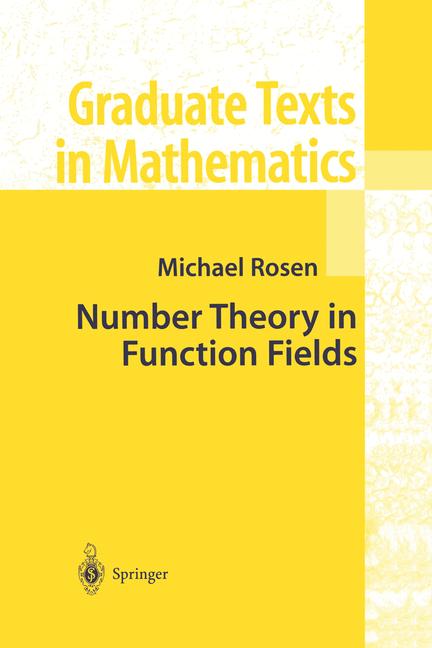
Number Theory in Function Fields
☆☆☆☆☆
(0 reviews)
Lowest price (incl. delivery)
64,19 EUR
Typical price63,81 PLN
Lowest (90 days)50,28 PLN
Offers6
Last updated1 tuần trước
Price history (90 days)
Full history
2026-08-08
2026-08-15
| Cập nhật lúc | Giá |
|---|---|
| 2026-08-08 | 50,28 |
| 2026-08-14 | 50,28 |
| 2026-08-15 | 59,99 |
| Người bán | Product price | Delivery | Tổng cộng | Tình trạng | Updated | |
|---|---|---|---|---|---|---|
| SP SpringerNatureLink Shop INT | 64,19 EUR | free | 64,19 EUR | Có sẵn | 3 ngày trước | View offer |
| SP Springer Nature Author | 69,99 USD | 29,00 USD | 98,99 USD | Có sẵn | 1 tuần trước | View offer |
| SP SpringerNatureLink Shop INT | 84,99 USD | 19,00 USD | 103,99 USD | Có sẵn | 3 ngày trước | View offer |
| SP SpringerNatureLink Shop INT | 84,99 USD | 15,00 USD | 99,99 USD | Có sẵn | 3 ngày trước | View offer |
| SP SpringerNatureLink Shop INT | 99,00 USD | 29,00 USD | 128,00 USD | Có sẵn | 3 ngày trước | View offer |
| SP SpringerNatureLink Shop INT | 99,00 USD | free | 99,00 USD | Có sẵn | 3 ngày trước | View offer |
Giá và tình trạng có thể thay đổi. Cập nhật lần cuối: 08.08.2026 13:27.
0,0
☆☆☆☆☆
0 reviews
5★
0%
4★
0%
3★
0%
2★
0%
1★
0%
Product reviews
No reviews yet — be the first!
Elementary number theory is concerned with the arithmetic properties of the ring of integers, Z, and its field of fractions, the rational numbers, Q. Early on in the development of the subject it was noticed that Z has many properties in common with A = IF[T], the ring of polynomials over a finite field. Both rings are principal ideal domains, both have the property that the residue class ring of any non-zero ideal is finite, both rings have infinitely many prime elements, and both rings have finitely many units. Thus, one is led to suspect that many results which hold for Z have analogues of the ring A. This is indeed the case. The first four chapters of this book are devoted to illustrating this by presenting, for example, analogues of the little theorems of Fermat and Euler, Wilson's theorem, quadratic (and higher) reciprocity, the prime number theorem, and Dirichlet's theorem on primes in an arithmetic progression. All these results have been known for a long time, but it is hard to locate any exposition of them outside of the original papers. Algebraic number theory arises from elementary number theory by con sidering finite algebraic extensions K of Q, which are called algebraic num ber fields, and investigating properties of the ring of algebraic integers OK C K, defined as the integral closure of Z in K.
Similar products
 50 Years of Philosophy and Medicine
from $107.30
50 Years of Philosophy and Medicine
from $107.30
 Understanding Cybersecurity Law and Digital Privacy
from $122.63
Understanding Cybersecurity Law and Digital Privacy
from $122.63
 Decisions in International Trade and Logistics
from $122.63
Decisions in International Trade and Logistics
from $122.63
 Advances in Economic Measurement
from $122.63
Advances in Economic Measurement
from $122.63
 Nanomaterials
from $137.96
Nanomaterials
from $137.96
 Sustainable Scaffolds-based Strategies in Tissue Engineering and Regenerative Medicine
from $162.87
Sustainable Scaffolds-based Strategies in Tissue Engineering and Regenerative Medicine
from $162.87
 Narratives in Educational Research
from $162.87
Narratives in Educational Research
from $162.87
 Environmental Biology of the Young Chinese Sturgeon
from $210.78
Environmental Biology of the Young Chinese Sturgeon
from $210.78