
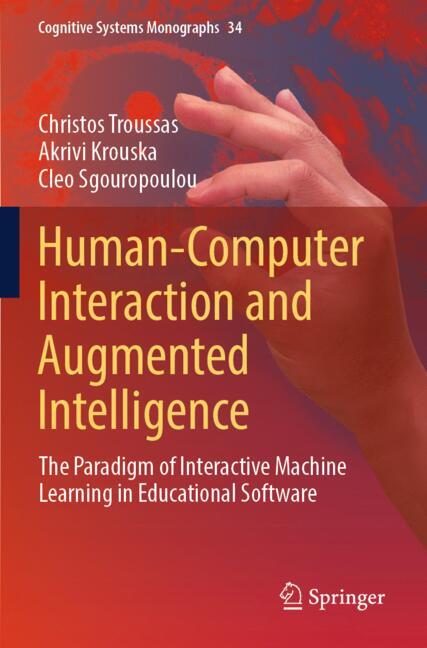
Human-Computer Interaction and Augmented Intelligence
☆☆☆☆☆
(0 reviews)
Lowest price (incl. delivery)
21 474,00 JPY
Typical price2 707,09 PLN
Lowest (90 days)117,69 PLN
Offers6
Last updated1 tuần trước
Price history (90 days)
Full history
2026-08-08
2026-08-15
| Cập nhật lúc | Giá |
|---|---|
| 2026-08-08 | 117,69 |
| 2026-08-15 | 117,69 |
| Người bán | Product price | Delivery | Tổng cộng | Tình trạng | Updated | |
|---|---|---|---|---|---|---|
| SP SpringerNatureLink Shop INT | 21 449,00 JPY | 25,00 JPY | 21 474,00 JPY | Có sẵn | 1 ngày trước | View offer |
| SP Springer Nature Author | 21 449,00 JPY | 25,00 JPY | 21 474,00 JPY | Có sẵn | 1 tuần trước | View offer |
| SP SpringerNatureLink Shop INT | 149,99 USD | 29,00 USD | 178,99 USD | Có sẵn | 1 ngày trước | View offer |
| SP SpringerNatureLink Shop INT | 169,99 USD | 19,00 USD | 188,99 USD | Có sẵn | 1 ngày trước | View offer |
| SP SpringerNatureLink Shop INT | 169,99 USD | 15,00 USD | 184,99 USD | Có sẵn | 1 ngày trước | View offer |
| SP SpringerNatureLink Shop INT | 177,00 EUR | free | 177,00 EUR | Có sẵn | 1 ngày trước | View offer |
Giá và tình trạng có thể thay đổi. Cập nhật lần cuối: 08.08.2026 23:28.
0,0
☆☆☆☆☆
0 reviews
5★
0%
4★
0%
3★
0%
2★
0%
1★
0%
Product reviews
No reviews yet — be the first!
This book explores the transformative roles of human-computer interaction (HCI) and augmented intelligence (AI) in shaping intelligent systems. HCI focuses on designing interactive systems that enhance human-technology relationships, while AI empowers users with adaptive, data-driven tools that complement decision-making. Together, these fields drive innovation, creating systems that are efficient, intuitive, and inclusive, addressing diverse user needs across various domains. Central to this work is the paradigm of interactive machine learning (IML), which builds on HCI and AI principles to create adaptive systems capable of evolving in real-time. The book highlights the application of IML in educational software, demonstrating how dynamic, personalized, and responsive learning environments can enhance student engagement and success. It provides detailed case studies and practical examples that showcase how IML aligns educational content, feedback, and interactions with learner behaviors and preferences. Additionally, it includes numerous Python code implementations and actionable design strategies, making these concepts accessible to practitioners and researchers alike. Key topics include leveraging cognitive and communication styles to shape adaptive systems, integrating learning models to enhance personalization, and addressing ethical considerations such as data privacy and algorithmic fairness. Readers will also discover discussions on creating personalized tutoring systems, collaborative platforms, and immersive environments that redefine educational technology. This book is a valuable resource for researchers, software developers, educators, instructional designers, and technologists at the intersection of human-computer interaction, augmented intelligence, and educational innovation. With its comprehensive framework and practical insights, it offers the tools to design adaptive, inclusive, and impactful learning systems for the future.
Similar products
 50 Years of Philosophy and Medicine
from $107.30
50 Years of Philosophy and Medicine
from $107.30
 Understanding Cybersecurity Law and Digital Privacy
from $122.63
Understanding Cybersecurity Law and Digital Privacy
from $122.63
 Decisions in International Trade and Logistics
from $122.63
Decisions in International Trade and Logistics
from $122.63
 Advances in Economic Measurement
from $122.63
Advances in Economic Measurement
from $122.63
 Nanomaterials
from $137.96
Nanomaterials
from $137.96
 Sustainable Scaffolds-based Strategies in Tissue Engineering and Regenerative Medicine
from $162.87
Sustainable Scaffolds-based Strategies in Tissue Engineering and Regenerative Medicine
from $162.87
 Narratives in Educational Research
from $162.87
Narratives in Educational Research
from $162.87
 Environmental Biology of the Young Chinese Sturgeon
from $210.78
Environmental Biology of the Young Chinese Sturgeon
from $210.78