
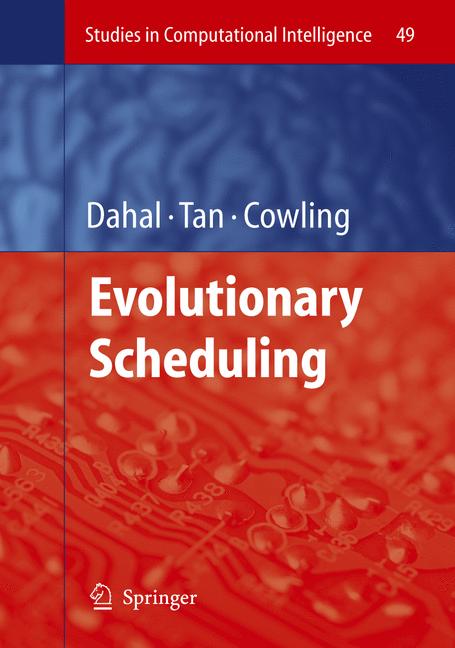
Evolutionary Scheduling
☆☆☆☆☆
(0 reviews)
Lowest price (incl. delivery)
21 468,00 JPY
Typical price2 768,83 PLN
Lowest (90 days)117,69 PLN
Offers6
Last updated6 ngày trước
Price history (90 days)
Full history
2026-08-08
2026-08-15
| Cập nhật lúc | Giá |
|---|---|
| 2026-08-08 | 117,69 |
| 2026-08-15 | 117,69 |
| Người bán | Product price | Delivery | Tổng cộng | Tình trạng | Updated | |
|---|---|---|---|---|---|---|
| SP SpringerNatureLink Shop INT | 21 449,00 JPY | 19,00 JPY | 21 468,00 JPY | Có sẵn | 8 giờ trước | View offer |
| SP Springer Nature Author | 21 449,00 JPY | 25,00 JPY | 21 474,00 JPY | Có sẵn | 6 ngày trước | View offer |
| SP SpringerNatureLink Shop INT | 149,99 USD | 15,00 USD | 164,99 USD | Có sẵn | 10 giờ trước | View offer |
| SP SpringerNatureLink Shop INT | 169,99 USD | 19,00 USD | 188,99 USD | Có sẵn | 9 giờ trước | View offer |
| SP SpringerNatureLink Shop INT | 169,99 USD | 25,00 USD | 194,99 USD | Có sẵn | 9 giờ trước | View offer |
| SP SpringerNatureLink Shop INT | 177,00 EUR | 15,00 EUR | 192,00 EUR | Có sẵn | 9 giờ trước | View offer |
Giá và tình trạng có thể thay đổi. Cập nhật lần cuối: 08.08.2026 23:28.
0,0
☆☆☆☆☆
0 reviews
5★
0%
4★
0%
3★
0%
2★
0%
1★
0%
Product reviews
No reviews yet — be the first!
Evolutionary scheduling is a vital research domain at the interface of two important sciences - artificial intelligence and operational research. Scheduling problems are generally complex, large scale, constrained, and multi-objective in nature, and classical operational research techniques are often inadequate at solving them effectively. With the advent of computation intelligence, there is renewed interest in solving scheduling problems using evolutionary computational techniques. These techniques, which include genetic algorithms, genetic programming, evolutionary strategies, memetic algorithms, particle swarm optimization, ant colony systems, etc, are derived from biologically inspired concepts and are well-suited to solve scheduling problems since they are highly scalable and flexible in terms of handling constraints and multiple objectives. This edited book gives an overview of many of the current developments in the large and growing field of evolutionary scheduling, and demonstrates the applicability of evolutionary computational techniques to solve scheduling problems, not only to small-scale test problems, but also fully-fledged real-world problems. The intended readers of this book are engineers, researchers, practitioners, senior undergraduates, and graduate students who are interested in the field of evolutionary scheduling.
Similar products
 50 Years of Philosophy and Medicine
from $107.30
50 Years of Philosophy and Medicine
from $107.30
 Understanding Cybersecurity Law and Digital Privacy
from $122.63
Understanding Cybersecurity Law and Digital Privacy
from $122.63
 Decisions in International Trade and Logistics
from $122.63
Decisions in International Trade and Logistics
from $122.63
 Advances in Economic Measurement
from $122.63
Advances in Economic Measurement
from $122.63
 Nanomaterials
from $137.96
Nanomaterials
from $137.96
 Sustainable Scaffolds-based Strategies in Tissue Engineering and Regenerative Medicine
from $162.87
Sustainable Scaffolds-based Strategies in Tissue Engineering and Regenerative Medicine
from $162.87
 Narratives in Educational Research
from $162.87
Narratives in Educational Research
from $162.87
 Environmental Biology of the Young Chinese Sturgeon
from $210.78
Environmental Biology of the Young Chinese Sturgeon
from $210.78