
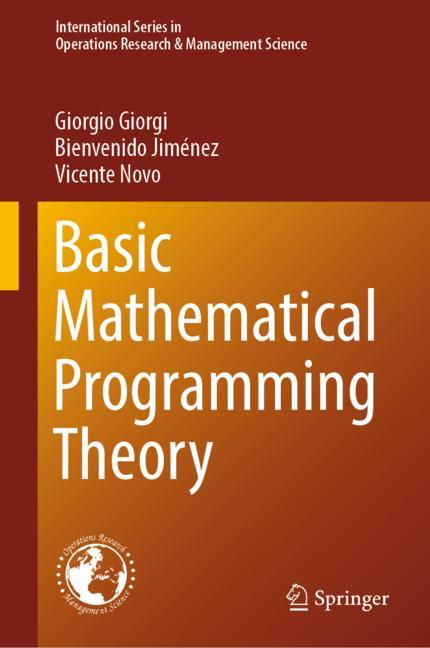
Basic Mathematical Programming Theory
☆☆☆☆☆
(0 reviews)
Lowest price (incl. delivery)
128,99 USD
Typical price1 217,30 PLN
Lowest (90 days)84,99 PLN
Offers2
Last updated15 giờ trước
| Người bán | Product price | Delivery | Tổng cộng | Tình trạng | Updated | |
|---|---|---|---|---|---|---|
| SP SpringerNatureLink Shop INT | 109,99 USD | 19,00 USD | 128,99 USD | Có sẵn | 1 ngày trước | View offer |
| SP Springer Nature Author | 18 589,00 JPY | 15,00 JPY | 18 604,00 JPY | Có sẵn | 15 giờ trước | View offer |
Giá và tình trạng có thể thay đổi. Cập nhật lần cuối: 08.08.2026 23:20.
0,0
☆☆☆☆☆
0 reviews
5★
0%
4★
0%
3★
0%
2★
0%
1★
0%
Product reviews
No reviews yet — be the first!
The subject of (static) optimization, also called mathematical programming, is one of the most important and widespread branches of modern mathematics, serving as a cornerstone of such scientific subjects as economic analysis, operations research, management sciences, engineering, chemistry, physics, statistics, computer science, biology, and social sciences. This book presents a unified, progressive treatment of the basic mathematical tools of mathematical programming theory. The authors expose said tools, along with results concerning the most common mathematical programming problems formulated in a finite-dimensional setting, forming the basis for further study of the basic questions on the various algorithmic methods and the most important particular applications of mathematical programming problems. This book assumes no previous experience in optimization theory, and the treatment of the various topics is largely self-contained. Prerequisites are the basic tools of differential calculus for functions of several variables, the basic notions of topology and of linear algebra, and the basic mathematical notions and theoretical background used in analyzing optimization problems. The book is aimed at both undergraduate and postgraduate students interested in mathematical programming problems but also those professionals who use optimization methods and wish to learn the more theoretical aspects of these questions.
Similar products
 Patient Safety Coaching
from $91.97
Patient Safety Coaching
from $91.97
 Ethnography and Diversity
from $69.30
Ethnography and Diversity
from $69.30
 Smart Villages
from $91.97
Smart Villages
from $91.97
 Nuclear Non-Proliferation in International Law - Volume VI
from $91.97
Nuclear Non-Proliferation in International Law - Volume VI
from $91.97
 The Price of Freedom
from $91.97
The Price of Freedom
from $91.97
 Eco-Social Policy in the OECD and the World Bank
from $91.97
Eco-Social Policy in the OECD and the World Bank
from $91.97
 Special Topics in Policing
from $122.58
Special Topics in Policing
from $122.58
 Music from the Heart
from $91.97
Music from the Heart
from $91.97