
User-Level Workflow Design
☆☆☆☆☆
(0 reviews)
Lowest price (incl. delivery)
54,99 USD
Typical price42,84 PLN
Lowest (90 days)37,44 PLN
Offers7
Last updated1 тиждень тому
Price history (90 days)
Full history
2026-08-08
2026-08-14
| Оновлено | Ціна |
|---|---|
| 2026-08-08 | 37,44 |
| 2026-08-14 | 37,44 |
| Продавець | Product price | Delivery | Усього | Наявність | Updated | |
|---|---|---|---|---|---|---|
| SP Springer Nature Author | 39,99 USD | 15,00 USD | 54,99 USD | Доступно | 6 днів тому | View offer |
| SP SpringerNatureLink Shop INT | 46,00 USD | free | 46,00 USD | Доступно | 16 годин тому | View offer |
| SP SpringerNatureLink Shop INT | 46,00 USD | 15,00 USD | 61,00 USD | Доступно | 16 годин тому | View offer |
| SP SpringerNatureLink Shop INT | 49,99 USD | 15,00 USD | 64,99 USD | Доступно | 16 годин тому | View offer |
| SP SpringerNatureLink Shop INT | 49,99 USD | 15,00 USD | 64,99 USD | Доступно | 16 годин тому | View offer |
| SP Springer Nature Author | 49,99 USD | free | 49,99 USD | Доступно | 6 днів тому | View offer |
| SP SpringerNatureLink Shop INT | 39,99 GBP | 25,00 GBP | 64,99 GBP | Доступно | 17 годин тому | View offer |
Ціни та наявність можуть змінюватися. Останнє оновлення: 08.08.2026 08:18.
0,0
☆☆☆☆☆
0 reviews
5★
0%
4★
0%
3★
0%
2★
0%
1★
0%
Product reviews
No reviews yet — be the first!
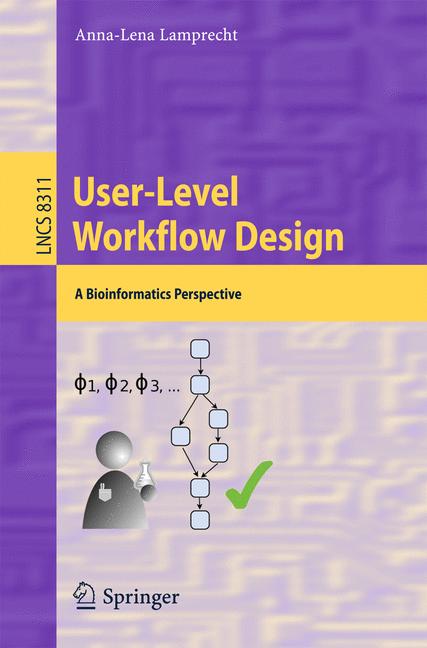
The continuous trend in computer science to lift programming to higher abstraction levels increases scalability and opens programming to a wider public. In particular, service-oriented programming and the support of semantics-based frameworks make application development accessible to users with almost no programming expertise. This monograph establishes requirement-centric scientific workflow design as an instance of consequent constraint-driven development. Requirements formulated in terms of user-level constraints are automatically transformed into running applications using temporal logic-based synthesis technology. The impact of this approach is illustrated by applying it to four very different bioinformatics scenarios: phylogenetic analysis, the dedicated GeneFisher-P scenario, the FiatFlux-P scenario, and microarray data analyses.
Similar products
 50 Years of Philosophy and Medicine
from $107.30
50 Years of Philosophy and Medicine
from $107.30
 Understanding Cybersecurity Law and Digital Privacy
from $122.63
Understanding Cybersecurity Law and Digital Privacy
from $122.63
 Decisions in International Trade and Logistics
from $122.63
Decisions in International Trade and Logistics
from $122.63
 Advances in Economic Measurement
from $122.63
Advances in Economic Measurement
from $122.63
 Nanomaterials
from $137.96
Nanomaterials
from $137.96
 Sustainable Scaffolds-based Strategies in Tissue Engineering and Regenerative Medicine
from $162.87
Sustainable Scaffolds-based Strategies in Tissue Engineering and Regenerative Medicine
from $162.87
 Narratives in Educational Research
from $162.87
Narratives in Educational Research
from $162.87
 Environmental Biology of the Young Chinese Sturgeon
from $210.78
Environmental Biology of the Young Chinese Sturgeon
from $210.78