
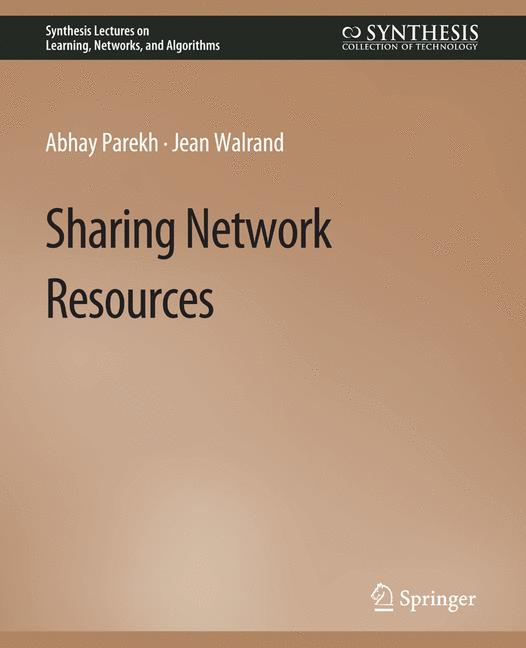
Sharing Network Resources
☆☆☆☆☆
(0 reviews)
Lowest price (incl. delivery)
4 737,00 JPY
Typical price293,82 PLN
Lowest (90 days)9,90 PLN
Offers3
Last updated1 день тому
Price history (90 days)
Full history
2026-08-07
2026-08-08
| Оновлено | Ціна |
|---|---|
| 2026-08-07 | 9,90 |
| 2026-08-08 | 34,80 |
| Продавець | Product price | Delivery | Усього | Наявність | Updated | |
|---|---|---|---|---|---|---|
| SP Springer Nature Author | 4 718,00 JPY | 19,00 JPY | 4 737,00 JPY | Доступно | 23 години тому | View offer |
| SP SpringerNatureLink Shop INT | 39,00 EUR | 29,00 EUR | 68,00 EUR | Доступно | 1 день тому | View offer |
| VI VitalSource | 199,24 ZAR | 15,00 ZAR | 214,24 ZAR | Доступно | 1 день тому | View offer |
Ціни та наявність можуть змінюватися. Останнє оновлення: 08.08.2026 05:21.
EAN
9783031792656
Springer Nature
0,0
☆☆☆☆☆
0 reviews
5★
0%
4★
0%
3★
0%
2★
0%
1★
0%
Product reviews
No reviews yet — be the first!
Resource Allocation lies at the heart of network control. In the early days of the Internet the scarcest resource was bandwidth, but as the network has evolved to become an essential utility in the lives of billions, the nature of the resource allocation problem has changed. This book attempts to describe the facets of resource allocation that are most relevant to modern networks. It is targeted at graduate students and researchers who have an introductory background in networking and who desire to internalize core concepts before designing new protocols and applications. We start from the fundamental question: what problem does network resource allocation solve? This leads us, in Chapter 1, to examine what it means to satisfy a set of user applications that have different requirements of the network, and to problems in Social Choice Theory. We find that while capturing these preferences in terms of utility is clean and rigorous, there are significant limitations to this choice. Chapter 2 focuses on sharing divisible resources such as links and spectrum. Both of these resources are somewhat atypical -- a link is most accurately modeled as a queue in our context, but this leads to the analytical intractability of queueing theory, and spectrum allocation methods involve dealing with interference, a poorly understood phenomenon. Chapters 3 and 4 are introductions to two allocation workhorses: auctions and matching. In these chapters we allow the users to game the system (i.e., to be strategic), but don't allow them to collude. In Chapter 5, we relax this restriction and focus on collaboration. Finally, in Chapter 6, we discuss the theoretical yet fundamental issue of stability. Here, our contribution is mostly on making a mathematically abstruse subdiscipline more accessible without losing too much generality.
Similar products
 Patient Safety Coaching
from $91.97
Patient Safety Coaching
from $91.97
 Ethnography and Diversity
from $69.30
Ethnography and Diversity
from $69.30
 Smart Villages
from $91.97
Smart Villages
from $91.97
 Nuclear Non-Proliferation in International Law - Volume VI
from $91.97
Nuclear Non-Proliferation in International Law - Volume VI
from $91.97
 The Price of Freedom
from $91.97
The Price of Freedom
from $91.97
 Eco-Social Policy in the OECD and the World Bank
from $91.97
Eco-Social Policy in the OECD and the World Bank
from $91.97
 Special Topics in Policing
from $122.58
Special Topics in Policing
from $122.58
 Music from the Heart
from $91.97
Music from the Heart
from $91.97