
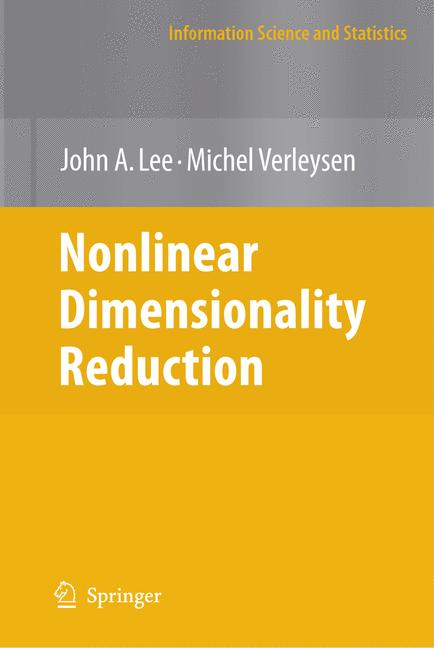
Nonlinear Dimensionality Reduction
☆☆☆☆☆
(0 reviews)
Lowest price (incl. delivery)
20 019,00 JPY
Typical price3 208,29 PLN
Lowest (90 days)119,99 PLN
Offers2
Last updated6 днів тому
| Продавець | Product price | Delivery | Усього | Наявність | Updated | |
|---|---|---|---|---|---|---|
| SP Springer Nature Author | 20 019,00 JPY | free | 20 019,00 JPY | Доступно | 6 днів тому | View offer |
| SP SpringerNatureLink Shop INT | 119,99 GBP | free | 119,99 GBP | Доступно | 34 хвилини тому | View offer |
Ціни та наявність можуть змінюватися. Останнє оновлення: 08.08.2026 23:32.
0,0
☆☆☆☆☆
0 reviews
5★
0%
4★
0%
3★
0%
2★
0%
1★
0%
Product reviews
No reviews yet — be the first!
Methods of dimensionality reduction provide a way to understand and visualize the structure of complex data sets. Traditional methods like principal component analysis and classical metric multidimensional scaling suffer from being based on linear models. Until recently, very few methods were able to reduce the data dimensionality in a nonlinear way. However, since the late nineties, many new methods have been developed and nonlinear dimensionality reduction, also called manifold learning, has become a hot topic. New advances that account for this rapid growth are, e.g. the use of graphs to represent the manifold topology, and the use of new metrics like the geodesic distance. In addition, new optimization schemes, based on kernel techniques and spectral decomposition, have lead to spectral embedding, which encompasses many of the recently developed methods. This book describes existing and advanced methods to reduce the dimensionality of numerical databases. For each method, the description starts from intuitive ideas, develops the necessary mathematical details, and ends by outlining the algorithmic implementation. Methods are compared with each other with the help of different illustrative examples. The purpose of the book is to summarize clear facts and ideas about well-known methods as well as recent developments in the topic of nonlinear dimensionality reduction. With this goal in mind, methods are all described from a unifying point of view, in order to highlight their respective strengths and shortcomings. The book is primarily intended for statisticians, computer scientists and data analysts. It is also accessible to other practitioners having a basic background in statistics and/or computational learning, like psychologists (in psychometry) and economists.
Similar products
 Die Handlungsform der interinstitutionellen Vereinbarung
from $139.00
Die Handlungsform der interinstitutionellen Vereinbarung
from $139.00
 Grundbegriffe der Handlungsformen der EU
from $139.00
Grundbegriffe der Handlungsformen der EU
from $139.00
 Advances in Cryptology 1981 - 1997
from $139.00
Advances in Cryptology 1981 - 1997
from $139.00
 Erich Preiser
from $139.00
Erich Preiser
from $139.00
 Impulse für eine europäische Harmonisierung des Urheberrechts / Perspectives d'harmonisation du droi
from $139.00
Impulse für eine europäische Harmonisierung des Urheberrechts / Perspectives d'harmonisation du droi
from $139.00
 Strategische Führung auf dem Prüfstand
from $139.00
Strategische Führung auf dem Prüfstand
from $139.00
 Grüne Gentechnik und Welthandel
from $139.00
Grüne Gentechnik und Welthandel
from $139.00
 Evaluation des Justizvollzugs
from $139.00
Evaluation des Justizvollzugs
from $139.00