
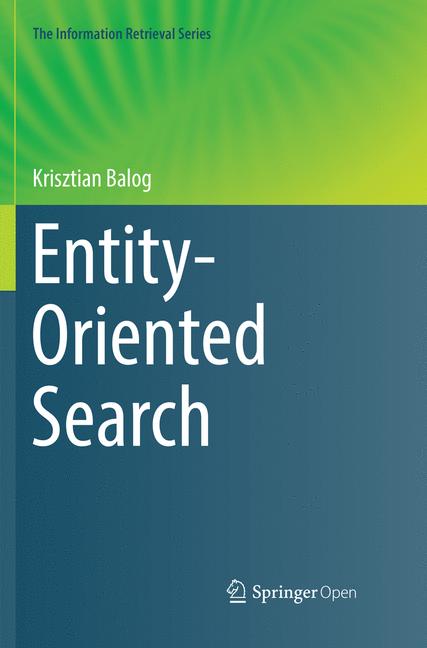
Entity-Oriented Search
☆☆☆☆☆
(0 reviews)
Lowest price (incl. delivery)
91,68 EUR
Typical price66,68 PLN
Lowest (90 days)66,68 PLN
Offers2
Last updated19 годин тому
| Продавець | Product price | Delivery | Усього | Наявність | Updated | |
|---|---|---|---|---|---|---|
| SP SpringerNatureLink Shop INT | 66,68 EUR | 25,00 EUR | 91,68 EUR | Доступно | 19 годин тому | View offer |
| SP Springer Nature Author | 66,68 EUR | 29,00 EUR | 95,68 EUR | Доступно | 10 годин тому | View offer |
Ціни та наявність можуть змінюватися. Останнє оновлення: 08.08.2026 11:48.
EAN
9783030067496
Springer Nature
0,0
☆☆☆☆☆
0 reviews
5★
0%
4★
0%
3★
0%
2★
0%
1★
0%
Product reviews
No reviews yet — be the first!
This open access book covers all facets of entity-oriented search—where “search” can be interpreted in the broadest sense of information access—from a unified point of view, and provides a coherent and comprehensive overview of the state of the art. It represents the first synthesis of research in this broad and rapidly developing area. Selected topics are discussed in-depth, the goal being to establish fundamental techniques and methods as a basis for future research and development. Additional topics are treated at a survey level only, containing numerous pointers to the relevant literature. A roadmap for future research, based on open issues and challenges identified along the way, rounds out the book. The book is divided into three main parts, sandwiched between introductory and concluding chapters. The first two chapters introduce readers to the basic concepts, provide an overview of entity-oriented search tasks, and present the various types andsources of data that will be used throughout the book. Part I deals with the core task of entity ranking: given a textual query, possibly enriched with additional elements or structural hints, return a ranked list of entities. This core task is examined in a number of different variants, using both structured and unstructured data collections, and numerous query formulations. In turn, Part II is devoted to the role of entities in bridging unstructured and structured data. Part III explores how entities can enable search engines to understand the concepts, meaning, and intent behind the query that the user enters into the search box, and how they can provide rich and focused responses (as opposed to merely a list of documents)—a process known as semantic search. The final chapter concludes the book by discussing the limitations of current approaches, and suggesting directions for future research. Researchers and graduate students are the primary target audience of this book. A general background in information retrieval is sufficient to follow the material, including an understanding of basic probability and statistics concepts as well as a basic knowledge of machine learning concepts and supervised learning algorithms.
Similar products
 Patient Safety Coaching
from $91.97
Patient Safety Coaching
from $91.97
 Ethnography and Diversity
from $69.30
Ethnography and Diversity
from $69.30
 Smart Villages
from $91.97
Smart Villages
from $91.97
 Nuclear Non-Proliferation in International Law - Volume VI
from $91.97
Nuclear Non-Proliferation in International Law - Volume VI
from $91.97
 The Price of Freedom
from $91.97
The Price of Freedom
from $91.97
 Eco-Social Policy in the OECD and the World Bank
from $91.97
Eco-Social Policy in the OECD and the World Bank
from $91.97
 Special Topics in Policing
from $122.58
Special Topics in Policing
from $122.58
 Music from the Heart
from $91.97
Music from the Heart
from $91.97