
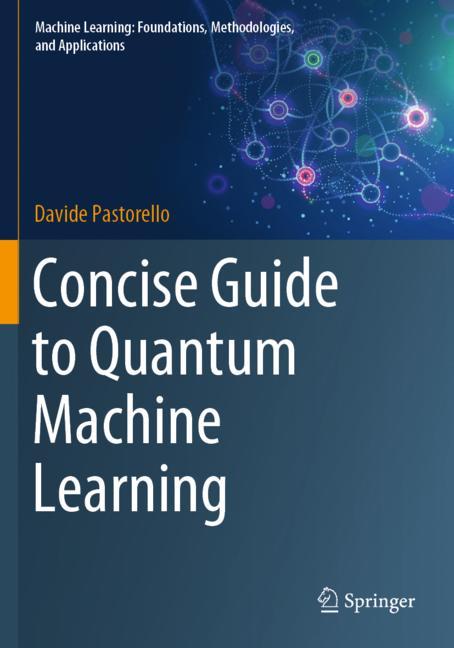
Concise Guide to Quantum Machine Learning
☆☆☆☆☆
(0 reviews)
Lowest price (incl. delivery)
116,99 USD
Typical price2 457,95 PLN
Lowest (90 days)89,87 PLN
Offers7
Last updated1 тиждень тому
Price history (90 days)
Full history
2026-08-08
2026-08-15
| Оновлено | Ціна |
|---|---|
| 2026-08-08 | 89,87 |
| 2026-08-15 | 89,87 |
| Продавець | Product price | Delivery | Усього | Наявність | Updated | |
|---|---|---|---|---|---|---|
| SP SpringerNatureLink Shop INT | 97,99 USD | 19,00 USD | 116,99 USD | Доступно | 3 дні тому | View offer |
| SP SpringerNatureLink Shop INT | 104,99 USD | free | 104,99 USD | Доступно | 3 дні тому | View offer |
| SP SpringerNatureLink Shop INT | 118,99 USD | 15,00 USD | 133,99 USD | Доступно | 3 дні тому | View offer |
| SP SpringerNatureLink Shop INT | 118,99 USD | 25,00 USD | 143,99 USD | Доступно | 3 дні тому | View offer |
| SP SpringerNatureLink Shop INT | 123,90 EUR | free | 123,90 EUR | Доступно | 3 дні тому | View offer |
| SP SpringerNatureLink Shop INT | 21 449,00 JPY | 29,00 JPY | 21 478,00 JPY | Доступно | 3 дні тому | View offer |
| SP Springer Nature Author | 21 449,00 JPY | 19,00 JPY | 21 468,00 JPY | Доступно | 1 тиждень тому | View offer |
Ціни та наявність можуть змінюватися. Останнє оновлення: 08.08.2026 22:41.
0,0
☆☆☆☆☆
0 reviews
5★
0%
4★
0%
3★
0%
2★
0%
1★
0%
Product reviews
No reviews yet — be the first!
This book offers a brief but effective introduction to quantum machine learning (QML). QML is not merely a translation of classical machine learning techniques into the language of quantum computing, but rather a new approach to data representation and processing. Accordingly, the content is not divided into a “classical part” that describes standard machine learning schemes and a “quantum part” that addresses their quantum counterparts. Instead, to immerse the reader in the quantum realm from the outset, the book starts from fundamental notions of quantum mechanics and quantum computing. Avoiding unnecessary details, it presents the concepts and mathematical tools that are essential for the required quantum formalism. In turn, it reviews those quantum algorithms most relevant to machine learning. Later chapters highlight the latest advances in this field and discuss the most promising directions for future research. To gain the most from this book, a basic grasp of statistics and linear algebra is sufficient; no previous experience with quantum computing or machine learning is needed. The book is aimed at researchers and students with no background in quantum physics and is also suitable for physicists looking to enter the field of QML.
Similar products
 50 Years of Philosophy and Medicine
from $107.30
50 Years of Philosophy and Medicine
from $107.30
 Understanding Cybersecurity Law and Digital Privacy
from $122.63
Understanding Cybersecurity Law and Digital Privacy
from $122.63
 Decisions in International Trade and Logistics
from $122.63
Decisions in International Trade and Logistics
from $122.63
 Advances in Economic Measurement
from $122.63
Advances in Economic Measurement
from $122.63
 Nanomaterials
from $137.96
Nanomaterials
from $137.96
 Sustainable Scaffolds-based Strategies in Tissue Engineering and Regenerative Medicine
from $162.87
Sustainable Scaffolds-based Strategies in Tissue Engineering and Regenerative Medicine
from $162.87
 Narratives in Educational Research
from $162.87
Narratives in Educational Research
from $162.87
 Environmental Biology of the Young Chinese Sturgeon
from $210.78
Environmental Biology of the Young Chinese Sturgeon
from $210.78