
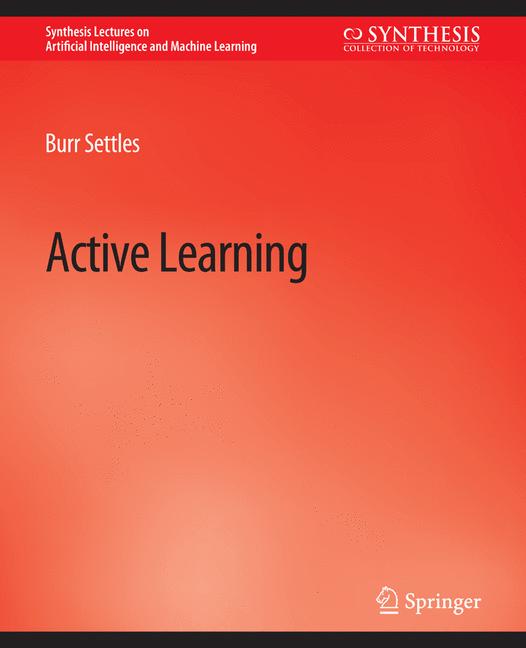
Active Learning
☆☆☆☆☆
(0 reviews)
Lowest price (incl. delivery)
38,10 EUR
Typical price590,01 PLN
Lowest (90 days)20,22 PLN
Offers2
Last updated21 годину тому
| Продавець | Product price | Delivery | Усього | Наявність | Updated | |
|---|---|---|---|---|---|---|
| SP SpringerNatureLink Shop INT | 23,10 EUR | 15,00 EUR | 38,10 EUR | Доступно | 1 день тому | View offer |
| SP Springer Nature Author | 4 003,00 JPY | 19,00 JPY | 4 022,00 JPY | Доступно | 21 годину тому | View offer |
Ціни та наявність можуть змінюватися. Останнє оновлення: 08.08.2026 23:06.
EAN
9783031015601
Springer Nature
0,0
☆☆☆☆☆
0 reviews
5★
0%
4★
0%
3★
0%
2★
0%
1★
0%
Product reviews
No reviews yet — be the first!
The key idea behind active learning is that a machine learning algorithm can perform better with less training if it is allowed to choose the data from which it learns. An active learner may pose "queries," usually in the form of unlabeled data instances to be labeled by an "oracle" (e.g., a human annotator) that already understands the nature of the problem. This sort of approach is well-motivated in many modern machine learning and data mining applications, where unlabeled data may be abundant or easy to come by, but training labels are difficult, time-consuming, or expensive to obtain. This book is a general introduction to active learning. It outlines several scenarios in which queries might be formulated, and details many query selection algorithms which have been organized into four broad categories, or "query selection frameworks." We also touch on some of the theoretical foundations of active learning, and conclude with an overview of the strengths and weaknesses of these approaches in practice, including a summary of ongoing work to address these open challenges and opportunities. Table of Contents: Automating Inquiry / Uncertainty Sampling / Searching Through the Hypothesis Space / Minimizing Expected Error and Variance / Exploiting Structure in Data / Theory / Practical Considerations
Similar products
 Patient Safety Coaching
from $91.97
Patient Safety Coaching
from $91.97
 Ethnography and Diversity
from $69.30
Ethnography and Diversity
from $69.30
 Smart Villages
from $91.97
Smart Villages
from $91.97
 Nuclear Non-Proliferation in International Law - Volume VI
from $91.97
Nuclear Non-Proliferation in International Law - Volume VI
from $91.97
 The Price of Freedom
from $91.97
The Price of Freedom
from $91.97
 Eco-Social Policy in the OECD and the World Bank
from $91.97
Eco-Social Policy in the OECD and the World Bank
from $91.97
 Special Topics in Policing
from $122.58
Special Topics in Policing
from $122.58
 Music from the Heart
from $91.97
Music from the Heart
from $91.97