
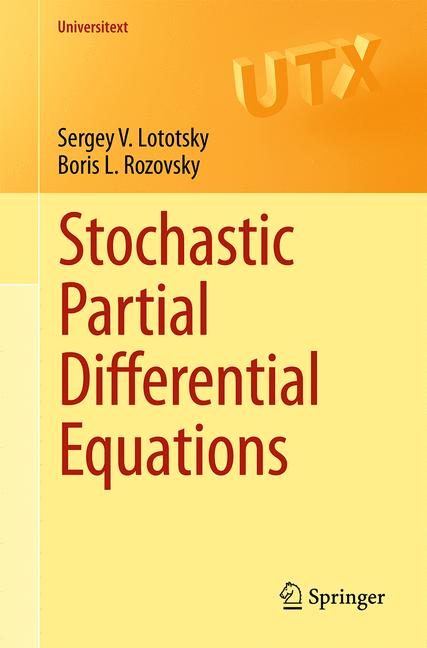
Stochastic Partial Differential Equations
☆☆☆☆☆
(0 reviews)
Lowest price (incl. delivery)
66,15 EUR
Typical price69,45 PLN
Lowest (90 days)17,50 PLN
Offers2
Last updated1 hafta önce
Price history (90 days)
Full history
2026-08-07
2026-08-15
| Güncellenme Tarihi | Fiyat |
|---|---|
| 2026-08-07 | 17,50 |
| 2026-08-08 | 32,09 |
| 2026-08-15 | 66,15 |
| Satıcı | Product price | Delivery | Toplam | Stok Durumu | Updated | |
|---|---|---|---|---|---|---|
| SP SpringerNatureLink Shop INT | 66,15 EUR | free | 66,15 EUR | Mevcut | 6 gün önce | View offer |
| VI VitalSource | 483,85 ZAR | 25,00 ZAR | 508,85 ZAR | Mevcut | 1 hafta önce | View offer |
Fiyatlar ve stok durumu değişebilir. Son Güncelleme: 08.08.2026 06:08.
EAN
9783319586458
Springer Nature
0,0
☆☆☆☆☆
0 reviews
5★
0%
4★
0%
3★
0%
2★
0%
1★
0%
Product reviews
No reviews yet — be the first!
Taking readers with a basic knowledge of probability and real analysis to the frontiers of a very active research discipline, this textbook provides all the necessary background from functional analysis and the theory of PDEs. It covers the main types of equations (elliptic, hyperbolic and parabolic) and discusses different types of random forcing. The objective is to give the reader the necessary tools to understand the proofs of existing theorems about SPDEs (from other sources) and perhaps even to formulate and prove a few new ones. Most of the material could be covered in about 40 hours of lectures, as long as not too much time is spent on the general discussion of stochastic analysis in infinite dimensions. As the subject of SPDEs is currently making the transition from the research level to that of a graduate or even undergraduate course, the book attempts to present enough exercise material to fill potential exams and homework assignments. Exercises appear throughout and are usually directly connected to the material discussed at a particular place in the text. The questions usually ask to verify something, so that the reader already knows the answer and, if pressed for time, can move on. Accordingly, no solutions are provided, but there are often hints on how to proceed. The book will be of interest to everybody working in the area of stochastic analysis, from beginning graduate students to experts in the field.
Similar products
 50 Years of Philosophy and Medicine
from $107.30
50 Years of Philosophy and Medicine
from $107.30
 Understanding Cybersecurity Law and Digital Privacy
from $122.63
Understanding Cybersecurity Law and Digital Privacy
from $122.63
 Decisions in International Trade and Logistics
from $122.63
Decisions in International Trade and Logistics
from $122.63
 Advances in Economic Measurement
from $122.63
Advances in Economic Measurement
from $122.63
 Nanomaterials
from $137.96
Nanomaterials
from $137.96
 Sustainable Scaffolds-based Strategies in Tissue Engineering and Regenerative Medicine
from $162.87
Sustainable Scaffolds-based Strategies in Tissue Engineering and Regenerative Medicine
from $162.87
 Narratives in Educational Research
from $162.87
Narratives in Educational Research
from $162.87
 Environmental Biology of the Young Chinese Sturgeon
from $210.78
Environmental Biology of the Young Chinese Sturgeon
from $210.78