
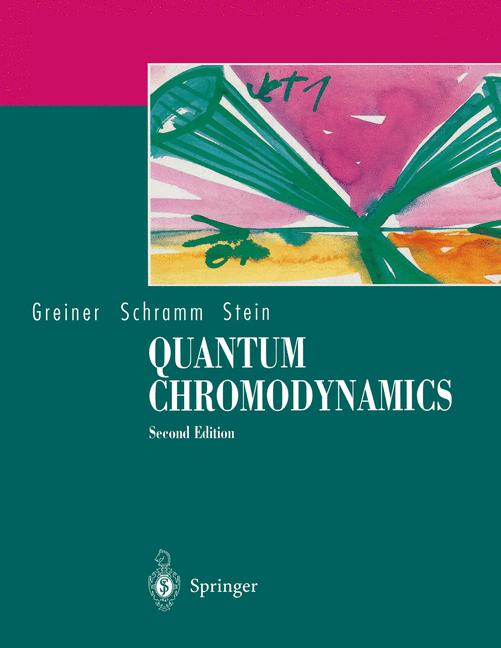
Quantum Chromodynamics
☆☆☆☆☆
(0 reviews)
Lowest price (incl. delivery)
9 166,00 JPY
Typical price981,80 PLN
Lowest (90 days)56,99 PLN
Offers3
Last updated1 hafta önce
Price history (90 days)
Full history
2026-08-08
2026-08-15
| Güncellenme Tarihi | Fiyat |
|---|---|
| 2026-08-08 | 56,99 |
| 2026-08-15 | 56,99 |
| Satıcı | Product price | Delivery | Toplam | Stok Durumu | Updated | |
|---|---|---|---|---|---|---|
| SP SpringerNatureLink Shop INT | 9 151,00 JPY | 15,00 JPY | 9 166,00 JPY | Mevcut | 6 gün önce | View offer |
| SP Springer Nature Author | 9 151,00 JPY | 15,00 JPY | 9 166,00 JPY | Mevcut | 1 hafta önce | View offer |
| SP SpringerNatureLink Shop INT | 85,00 EUR | 25,00 EUR | 110,00 EUR | Mevcut | 6 gün önce | View offer |
Fiyatlar ve stok durumu değişebilir. Son Güncelleme: 08.08.2026 23:18.
EAN
9783662047071
Springer Nature
0,0
☆☆☆☆☆
0 reviews
5★
0%
4★
0%
3★
0%
2★
0%
1★
0%
Product reviews
No reviews yet — be the first!
The theory of strong interactions, quantum chromodynamics (QCD), was for mulated 30 years ago and has since been a very active field of research. The underlying equations of motion for the gauge degrees of freedom are nonlin ear and minimally coupled to fermions with global and local SU(3) charges. This leads to spectacular problems compared with those of QED since the gauge bosons themselves interact with each other. On the other hand, it is exactly the self-interaction of the gluons which leads to asymptotic freedom and the pos sibility to calcuate quark-gluon interaction at small distances in the framework of perturbation theory. We discover one of the most complicated but most beau tiful gauge theories which poses extremely challenging problems on modem theoretical and experimental physics today. Quantum chromodynamics is the quantum field theory that allows us to cal culate the propagation and interaction of colored quarks and gluons at small distances. Today's experiments do not allow these colored objects to be detected directly; instead one deals with colorless hadrons: mesons and baryons seen far away from the actual interaction point. The hadronization itself is a complicated process and not yet understood from first principles. Therefore one may won der how the signature of quark and gluon interactions can be traced through the process of hadronization.
Similar products
 50 Years of Philosophy and Medicine
from $107.30
50 Years of Philosophy and Medicine
from $107.30
 Understanding Cybersecurity Law and Digital Privacy
from $122.63
Understanding Cybersecurity Law and Digital Privacy
from $122.63
 Decisions in International Trade and Logistics
from $122.63
Decisions in International Trade and Logistics
from $122.63
 Advances in Economic Measurement
from $122.63
Advances in Economic Measurement
from $122.63
 Nanomaterials
from $137.96
Nanomaterials
from $137.96
 Sustainable Scaffolds-based Strategies in Tissue Engineering and Regenerative Medicine
from $162.87
Sustainable Scaffolds-based Strategies in Tissue Engineering and Regenerative Medicine
from $162.87
 Narratives in Educational Research
from $162.87
Narratives in Educational Research
from $162.87
 Environmental Biology of the Young Chinese Sturgeon
from $210.78
Environmental Biology of the Young Chinese Sturgeon
from $210.78