
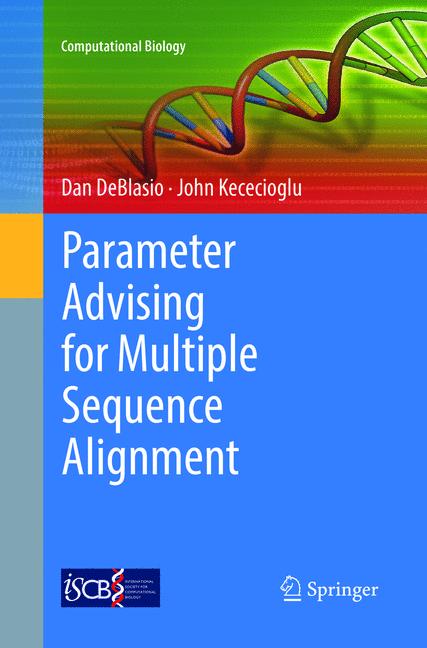
Parameter Advising for Multiple Sequence Alignment
☆☆☆☆☆
(0 reviews)
Lowest price (incl. delivery)
7 164,00 JPY
Typical price321,86 PLN
Lowest (90 days)39,99 PLN
Offers2
Last updated16 saat önce
| Satıcı | Product price | Delivery | Toplam | Stok Durumu | Updated | |
|---|---|---|---|---|---|---|
| SP Springer Nature Author | 7 149,00 JPY | 15,00 JPY | 7 164,00 JPY | Mevcut | 16 saat önce | View offer |
| SP SpringerNatureLink Shop INT | 59,00 EUR | 29,00 EUR | 88,00 EUR | Mevcut | 1 gün önce | View offer |
Fiyatlar ve stok durumu değişebilir. Son Güncelleme: 08.08.2026 23:09.
0,0
☆☆☆☆☆
0 reviews
5★
0%
4★
0%
3★
0%
2★
0%
1★
0%
Product reviews
No reviews yet — be the first!
This book develops a new approach called parameter advising for finding a parameter setting for a sequence aligner that yields a quality alignment of a given set of input sequences. In this framework, a parameter advisor is a procedure that automatically chooses a parameter setting for the input, and has two main ingredients: (a) the set of parameter choices considered by the advisor, and (b) an estimator of alignment accuracy used to rank alignments produced by the aligner. On coupling a parameter advisor with an aligner, once the advisor is trained in a learning phase, the user simply inputs sequences to align, and receives an output alignment from the aligner, where the advisor has automatically selected the parameter setting. The chapters first lay out the foundations of parameter advising, and then cover applications and extensions of advising. The content • examines formulations of parameter advising and their computational complexity, • develops methods for learning good accuracy estimators, • presents approximation algorithms for finding good sets of parameter choices, and • assesses software implementations of advising that perform well on real biological data. Also explored are applications of parameter advising to • adaptive local realignment, where advising is performed on local regions of the sequences to automatically adapt to varying mutation rates, and • ensemble alignment, where advising is applied to an ensemble of aligners to effectively yield a new aligner of higher quality than the individual aligners in the ensemble. The book concludes by offering future directions in advising research.
Similar products
 Patient Safety Coaching
from $91.97
Patient Safety Coaching
from $91.97
 Ethnography and Diversity
from $69.30
Ethnography and Diversity
from $69.30
 Smart Villages
from $91.97
Smart Villages
from $91.97
 Nuclear Non-Proliferation in International Law - Volume VI
from $91.97
Nuclear Non-Proliferation in International Law - Volume VI
from $91.97
 The Price of Freedom
from $91.97
The Price of Freedom
from $91.97
 Eco-Social Policy in the OECD and the World Bank
from $91.97
Eco-Social Policy in the OECD and the World Bank
from $91.97
 Special Topics in Policing
from $122.58
Special Topics in Policing
from $122.58
 Music from the Heart
from $91.97
Music from the Heart
from $91.97