
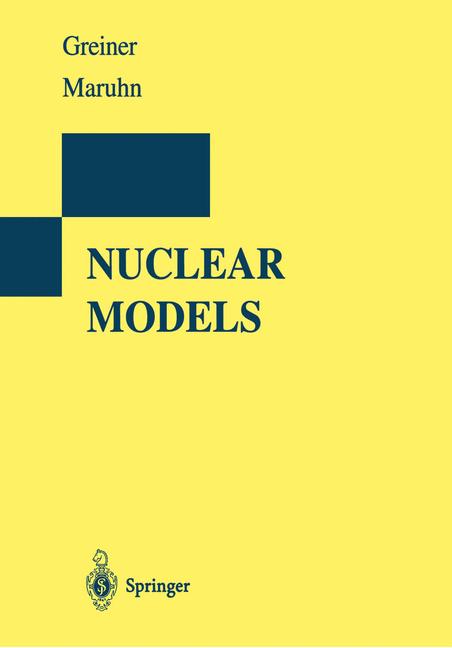
Nuclear Models
☆☆☆☆☆
(0 reviews)
Lowest price (incl. delivery)
156,50 GBP
Typical price169,00 PLN
Lowest (90 days)169,00 PLN
Offers2
Last updated1 hafta önce
| Satıcı | Product price | Delivery | Toplam | Stok Durumu | Updated | |
|---|---|---|---|---|---|---|
| SP SpringerNatureLink Shop INT | 131,50 GBP | 25,00 GBP | 156,50 GBP | Mevcut | 3 gün önce | View offer |
| SP Springer Nature Author | 169,00 USD | 29,00 USD | 198,00 USD | Mevcut | 1 hafta önce | View offer |
Fiyatlar ve stok durumu değişebilir. Son Güncelleme: 08.08.2026 22:35.
EAN
9783540591801
Springer Nature
0,0
☆☆☆☆☆
0 reviews
5★
0%
4★
0%
3★
0%
2★
0%
1★
0%
Product reviews
No reviews yet — be the first!
Theoretical physics has become a many-faceted science. For the young student it is difficult enough to cope with the overwhelming amount of new scientific material that has to be learned, let alone to obtain an overview of the entire field, which ranges from mechanics through electrodynamics, quantum mechanics, field theory, nuclear and heavy-ion science, statistical mechanics, thermodynamics, and solid state theory to elementary-particle physics. And this knowledge should be acquired in just 8-10 semesters during which, in addition, a Diploma or Master's thesis has to be worked on or examinations prepared for. All this can be achieved only if the university teachers help to introduce the student to the new disciplines as early on as possible, in order to create interest and excitement that in turn set free essential new energy. Naturally, all inessential material must simply be eliminated. At the Johann Wolfgang Goethe University in Frankfurt we therefore confront the student with theoretical physics immediately in the first semester. Theoretical Mechanics I and II, Electrodynamics, and Quantum Mechanics I - an Introduction are the basic courses during the first two years. These lectures are supplemented with many mathematical explanations and much support material. After the fourth semester of studies, graduate work begins and Quantum Mechanics II - Symme tries, Statistical Mechanics and Thermodynamics, Relativistic Quantum Mechanics, Quantum Electrodynamics, the Gauge Theory of Weak Interactions, and Quantum Chromodynamics are obligatory.
Similar products
 50 Years of Philosophy and Medicine
from $107.30
50 Years of Philosophy and Medicine
from $107.30
 Understanding Cybersecurity Law and Digital Privacy
from $122.63
Understanding Cybersecurity Law and Digital Privacy
from $122.63
 Decisions in International Trade and Logistics
from $122.63
Decisions in International Trade and Logistics
from $122.63
 Advances in Economic Measurement
from $122.63
Advances in Economic Measurement
from $122.63
 Nanomaterials
from $137.96
Nanomaterials
from $137.96
 Sustainable Scaffolds-based Strategies in Tissue Engineering and Regenerative Medicine
from $162.87
Sustainable Scaffolds-based Strategies in Tissue Engineering and Regenerative Medicine
from $162.87
 Narratives in Educational Research
from $162.87
Narratives in Educational Research
from $162.87
 Environmental Biology of the Young Chinese Sturgeon
from $210.78
Environmental Biology of the Young Chinese Sturgeon
from $210.78