
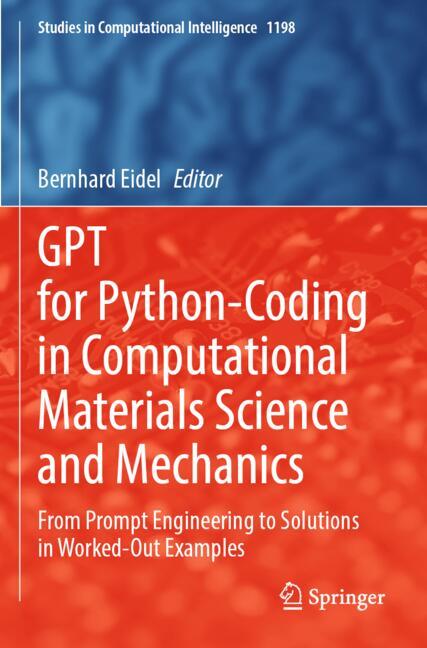
GPT for Python-Coding in Computational Materials Science and Mechanics
☆☆☆☆☆
(0 reviews)
Lowest price (incl. delivery)
164,79 EUR
Typical price182,58 PLN
Lowest (90 days)149,79 PLN
Offers7
Last updated1 hafta önce
Price history (90 days)
Full history
2026-08-08
2026-08-15
| Güncellenme Tarihi | Fiyat |
|---|---|
| 2026-08-08 | 149,79 |
| 2026-08-15 | 159,99 |
| Satıcı | Product price | Delivery | Toplam | Stok Durumu | Updated | |
|---|---|---|---|---|---|---|
| SP Springer Nature Author | 149,79 EUR | 15,00 EUR | 164,79 EUR | Mevcut | 1 hafta önce | View offer |
| SP SpringerNatureLink Shop INT | 179,99 USD | 19,00 USD | 198,99 USD | Mevcut | 1 hafta önce | View offer |
| SP SpringerNatureLink Shop INT | 179,99 USD | 15,00 USD | 194,99 USD | Mevcut | 1 hafta önce | View offer |
| SP SpringerNatureLink Shop INT | 199,99 USD | 19,00 USD | 218,99 USD | Mevcut | 1 hafta önce | View offer |
| SP SpringerNatureLink Shop INT | 199,99 USD | free | 199,99 USD | Mevcut | 1 hafta önce | View offer |
| SP Springer Nature Author | 199,99 USD | free | 199,99 USD | Mevcut | 1 hafta önce | View offer |
| SP SpringerNatureLink Shop INT | 197,99 EUR | 25,00 EUR | 222,99 EUR | Mevcut | 1 hafta önce | View offer |
Fiyatlar ve stok durumu değişebilir. Son Güncelleme: 15.08.2026 06:44.
0,0
☆☆☆☆☆
0 reviews
5★
0%
4★
0%
3★
0%
2★
0%
1★
0%
Product reviews
No reviews yet — be the first!
This book covers all the topics about ChatGPT required to successfully generate Python code to solve problems in computational materials science and mechanics, complemented by numerous fully worked-out applications. The complete work flow for AI-assisted coding is given, including: (i) prompt engineering providing a powerful toolset for how to give coding assignments to ChatGPT effectively; (ii) commented code listings; and (iii) tips and tricks to verify the codes in rigorous tests including human interventions to fix issues and gaps. Finally, (iv) the coding projects are critically reviewed to address the strengths and remaining weaknesses of the Chatbot, including explicit recommendations on how to communicate with GPT. For the steps (i)–(iv) the book presents a curated selection of intriguing problems from computational materials science and computational mechanics including machine learning for problem-solving. These problems are carefully chosen for their relevance to current research and industrial applications and their suitability for showcasing the advanced capabilities of GPT-4 for code generation. Spanning from predicting material behavior under various conditions to simulating complex mechanical interactions, the problems serve as a canvas on which GPT-4 paints its solutions, demonstrating not just accuracy but creativity in problem-solving. Therefore, the book serves as a valuable primer for both undergraduate and graduate students, as well as a review for research scientists and practicing engineers.
Similar products
 Gamma Knife Neurosurgery in the Management of Intracranial Disorders
from $210.78
Gamma Knife Neurosurgery in the Management of Intracranial Disorders
from $210.78
 SDGs in Construction Economics and Organization
from $210.78
SDGs in Construction Economics and Organization
from $210.78
 Emerging Therapies in Neurorehabilitation III
from $210.78
Emerging Therapies in Neurorehabilitation III
from $210.78
 Ground Improvement Techniques
from $220.36
Ground Improvement Techniques
from $220.36
 Anomaly Detection in Video Surveillance
from $220.36
Anomaly Detection in Video Surveillance
from $220.36
 Mechanism and Machine Science
from $287.42
Mechanism and Machine Science
from $287.42
 Protein-Protein Interactions as New Drug Targets
from $287.42
Protein-Protein Interactions as New Drug Targets
from $287.42
 Proceedings of the 7th International Conference of Transportation Research Group of India (CTRG 2023
from $287.42
Proceedings of the 7th International Conference of Transportation Research Group of India (CTRG 2023
from $287.42