
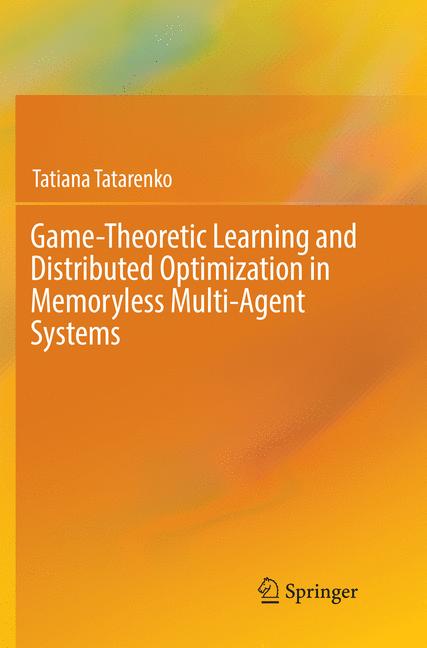
Game-Theoretic Learning and Distributed Optimization in Memoryless Multi-Agent Systems
☆☆☆☆☆
(0 reviews)
Lowest price (incl. delivery)
57,79 USD
Typical price470,40 PLN
Lowest (90 days)34,99 PLN
Offers7
Last updated1 hafta önce
Price history (90 days)
Full history
2026-08-08
2026-08-15
| Güncellenme Tarihi | Fiyat |
|---|---|
| 2026-08-08 | 42,79 |
| 2026-08-14 | 34,99 |
| 2026-08-15 | 51,99 |
| Satıcı | Product price | Delivery | Toplam | Stok Durumu | Updated | |
|---|---|---|---|---|---|---|
| SP SpringerNatureLink Shop INT | 42,79 USD | 15,00 USD | 57,79 USD | Mevcut | 1 hafta önce | View offer |
| SP SpringerNatureLink Shop INT | 7 149,00 JPY | 29,00 JPY | 7 178,00 JPY | Mevcut | 6 gün önce | View offer |
| SP Springer Nature Author | 7 149,00 JPY | 25,00 JPY | 7 174,00 JPY | Mevcut | 1 hafta önce | View offer |
| SP SpringerNatureLink Shop INT | 49,99 USD | 19,00 USD | 68,99 USD | Mevcut | 1 hafta önce | View offer |
| SP SpringerNatureLink Shop INT | 54,99 USD | 29,00 USD | 83,99 USD | Mevcut | 1 hafta önce | View offer |
| SP SpringerNatureLink Shop INT | 54,99 USD | 29,00 USD | 83,99 USD | Mevcut | 1 hafta önce | View offer |
| SP SpringerNatureLink Shop INT | 59,00 EUR | free | 59,00 EUR | Mevcut | 1 hafta önce | View offer |
Fiyatlar ve stok durumu değişebilir. Son Güncelleme: 08.08.2026 23:09.
0,0
☆☆☆☆☆
0 reviews
5★
0%
4★
0%
3★
0%
2★
0%
1★
0%
Product reviews
No reviews yet — be the first!
This book presents new efficient methods for optimization in realistic large-scale, multi-agent systems. These methods do not require the agents to have the full information about the system, but instead allow them to make their local decisions based only on the local information, possibly obtained during communication with their local neighbors. The book, primarily aimed at researchers in optimization and control, considers three different information settings in multi-agent systems: oracle-based, communication-based, and payoff-based. For each of these information types, an efficient optimization algorithm is developed, which leads the system to an optimal state. The optimization problems are set without such restrictive assumptions as convexity of the objective functions, complicated communication topologies, closed-form expressions for costs and utilities, and finiteness of the system’s state space.
Similar products
 50 Years of Philosophy and Medicine
from $107.30
50 Years of Philosophy and Medicine
from $107.30
 Understanding Cybersecurity Law and Digital Privacy
from $122.63
Understanding Cybersecurity Law and Digital Privacy
from $122.63
 Decisions in International Trade and Logistics
from $122.63
Decisions in International Trade and Logistics
from $122.63
 Advances in Economic Measurement
from $122.63
Advances in Economic Measurement
from $122.63
 Nanomaterials
from $137.96
Nanomaterials
from $137.96
 Sustainable Scaffolds-based Strategies in Tissue Engineering and Regenerative Medicine
from $162.87
Sustainable Scaffolds-based Strategies in Tissue Engineering and Regenerative Medicine
from $162.87
 Narratives in Educational Research
from $162.87
Narratives in Educational Research
from $162.87
 Environmental Biology of the Young Chinese Sturgeon
from $210.78
Environmental Biology of the Young Chinese Sturgeon
from $210.78