
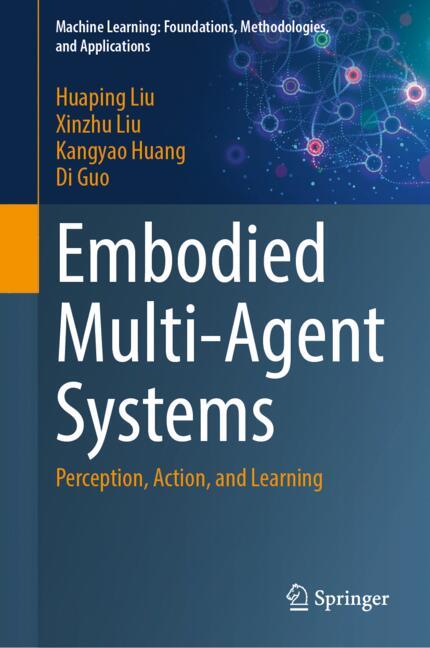
Embodied Multi-Agent Systems
☆☆☆☆☆
(0 reviews)
Lowest price (incl. delivery)
20 606,00 JPY
Typical price5 275,25 PLN
Lowest (90 days)170,00 PLN
Offers3
Last updated1 hafta önce
Price history (90 days)
Full history
2026-08-08
2026-08-15
| Güncellenme Tarihi | Fiyat |
|---|---|
| 2026-08-08 | 170,00 |
| 2026-08-15 | 170,00 |
| Satıcı | Product price | Delivery | Toplam | Stok Durumu | Updated | |
|---|---|---|---|---|---|---|
| SP SpringerNatureLink Shop INT | 20 591,00 JPY | 15,00 JPY | 20 606,00 JPY | Mevcut | 3 gün önce | View offer |
| SP Springer Nature Author | 20 591,00 JPY | free | 20 591,00 JPY | Mevcut | 1 hafta önce | View offer |
| SP SpringerNatureLink Shop INT | 170,00 EUR | free | 170,00 EUR | Mevcut | 3 gün önce | View offer |
Fiyatlar ve stok durumu değişebilir. Son Güncelleme: 08.08.2026 23:33.
EAN
9789819658718
Springer Nature
0,0
☆☆☆☆☆
0 reviews
5★
0%
4★
0%
3★
0%
2★
0%
1★
0%
Product reviews
No reviews yet — be the first!
In recent years, embodied multi-agent systems, including multi-robots, have emerged as essential solution for demanding tasks such as search and rescue, environmental monitoring, and space exploration. Effective collaboration among these agents is crucial but presents significant challenges due to differences in morphology and capabilities, especially in heterogenous systems. While existing books address collaboration control, perception, and learning, there is a gap in focusing on active perception and interactive learning for embodied multi-agent systems. This book aims to bridge this gap by establishing a unified framework for perception and learning in embodied multi-agent systems. It presents and discusses the perception-action-learning loop, offering systematic solutions for various types of agents—homogeneous, heterogeneous, and ad hoc. Beyond the popular reinforcement learning techniques, the book provides insights into using fundamental models to tackle complex collaboration problems. By interchangeably utilizing constrained optimization, reinforcement learning, and fundamental models, this book offers a comprehensive toolkit for solving different types of embodied multi-agent problems. Readers will gain an understanding of the advantages and disadvantages of each method for various tasks. This book will be particularly valuable to graduate students and professional researchers in robotics and machine learning. It provides a robust learning framework for addressing practical challenges in embodied multi-agent systems and demonstrates the promising potential of fundamental models for scenario generation, policy learning, and planning in complex collaboration problems.
Similar products
 50 Years of Philosophy and Medicine
from $107.30
50 Years of Philosophy and Medicine
from $107.30
 Understanding Cybersecurity Law and Digital Privacy
from $122.63
Understanding Cybersecurity Law and Digital Privacy
from $122.63
 Decisions in International Trade and Logistics
from $122.63
Decisions in International Trade and Logistics
from $122.63
 Advances in Economic Measurement
from $122.63
Advances in Economic Measurement
from $122.63
 Nanomaterials
from $137.96
Nanomaterials
from $137.96
 Sustainable Scaffolds-based Strategies in Tissue Engineering and Regenerative Medicine
from $162.87
Sustainable Scaffolds-based Strategies in Tissue Engineering and Regenerative Medicine
from $162.87
 Narratives in Educational Research
from $162.87
Narratives in Educational Research
from $162.87
 Environmental Biology of the Young Chinese Sturgeon
from $210.78
Environmental Biology of the Young Chinese Sturgeon
from $210.78